One of the cool things about mountain sports is not just the climbing or whatever, but the people who are also into them. This was driven home to me recently by two emails I received. The first was from Raphael Slawinski, who spent the summer climbing in Pakistan with a few other friends of mine. Raph, AKA Dr. Slawinski (he actually is a PhD.) wrote a really nice trip report up on the whole experience andposted it here.
Then there's my bud JD. He's been at the climbing game for a long time, from the anorexic rice cakes era to the present, and always cared about it. We've had some epic conversations about climbing, climbers and life. He recently sent me the following. It's full of the heat that climbing generates, posted with his permission:
JD LeBlanc's Rant:
Climbing – Market, Athletes & Media
by JD LeBlanc
Sport climbing came of age in North America thanks mostly to Alan Watts and his creation of Smith Rocks in the mid-1980’s. This led to an influx of climbers realizing that sport climbing could be “it” for them. Companies were keen to sponsor climbers who excelled at the sport – with the intent that it would help them with revenue and market share. The biggest problem besides the egos and dubious feats, was the fact that the industry was still very small.
The size of the industry may have been in the six figures in the 80’s – now maybe in the sevens – and the focus was on mountains, not sport crags. We had huge competition for athletes to become sponsored, but no real market to sell to. The athletic drive became so high and the return, so low, that many simply bailed out of the sport. Instead of building on the sport, we were actually losing climbers. Losing climbers really means losing participants – decreasing the industry. Early to mid-90s - indoor gyms take off in North America. This really allows access to the general public and provides a way for them to try climbing and ultimately bring in participants. Now the athlete can forge a way to become a professional climber (PC) – simply because the market became broader and general revenue larger, an increase in the number of the general climber (GC) – maybe like the NHL in the 50’s – you get paid, but just enough to be able to climb and train. Buying a home, new vehicles, lavish living expenses … off of a sponsored climber salary – unlikely, but living the life – traveling and climbing could be attained.
The Athlete truly comes of age after 10+ years of climbers’ efforts. However, unlike other sports, to see the athlete in action on their turf, is pretty hard for the general climber (GC) – videos, dvds and the gym provide glimpses of the athlete/Pro Climber (PC). But does this really matter and help in the growth of the sport? To see an athlete in their turf is to see what can be done and why they apply so much effort to do such. Motion pictures, of some form, provide visual, but no feel. Gyms provide live action, but it is hard to see the real aspects of the athlete and climbing. Moving over stone, ice … is not the same as plastic/wood. The real nature of the medium and conditions provide the ultimate performance and showcase what can be done. The passion is seen and this provides the general climber (GC) with a picture of what they may be able to do. The fact if a pro-climber (PC) sends 5.14, is not lost, but truly irrelevant to the GC. The fact they send a project provides the base for the GC to start to realize, they can achieve. Once this happens, then they are hooked and will try to bring their own into the sport. The PC has then done the part and what their sponsors want – to increase the participation – hence revenue.
What makes a good PC and why bother? What makes a good PC is one who does the above – captivates the GC into realizing there own potential. The PC does not have to be the one sending 5.15, M14, WI7, V15, 5.14 RX or hard Alpine – they do need to be able to climb within the top of their discipline, but mostly need to captivate. This does not mean they need to spray about what they sent, how quickly, or leave out the facts of numerous years, but only the recent tries. They do need to be known – local word of mouth, media reports, blogs, websites, slide-shows, events, coaching …
I have been fortunate to be in the industry since the mid-80s and have also been on both sides, athlete and industry. Here’s the dilemma, some athletes who may not be the best climbers, but maybe the BEST PCs have issues with other top climbers (TC). The industry needs the best PC they can get – they just don’t need the best TC. Here’s why; I know a PC who is not the best TC, but damn it, he is the best for his sponsors and brings the captivation to the GC – he gets a lot of grief from the TCs. Yep, some of the TCs are still stuck in the early days and can’t get over the concept of the business. He drives many GCs to slideshows and events and is very active in climbing. Whether or not I like him all the time, is irrelevant – he provides to the sport what we need, captivation of the GC. The sport itself needs routes and goals to drive the TCs and PCs – but the industry needs the GC captivation foremost. Let’s face it Ford sells more Focuses than their $200,000 Ford GT.
So here’s the sport PC debate in North America – Chris Sharma or Dave Graham? Sharma has set standards, and created a captivation on the GC and TC like no other North American sport climber. Graham has sent almost every hard route in Europe and North America – he is truly the TC in North America, but I believe lacks the media savvy to captivate – this does not mean he can’t, just that he needs help on it. Sharma seems to have a way and it comes across as such. Hence Sharma is the PC to follow – Graham is a PC, but more on the TC end. The North American media is the best method for captivation, but in the recent years, has focused more on the TC side.
The North American climbing media has gone through the same changes that the TCs and PCs have done. Currently I believe they are not where they should be. They focus more on the TC side of things and forget about the PC side – how to captivate? V15, 8b+ onsights, 5.15 redpoints, M14 sends, Everest sieged again, or deep water soloing.
Does deep water soloing captivate? Sure it does if you are a TC and can get to Mallorca. I believe that it exemplifies all that the PC has worked to get OVER, as it is more captivating for the TC than the GC. This does not mean it’s not a feat of climbing. GCs like ropes, gear and the conception that they may be able to emulate the PC on their own route at their crag or gym. To me it answers the: “if a tree falls in the forest and no one hears it, does it make a sound?” The media has answered this – if a climber climbs a really hard route on a rock in the middle of an ocean, alone with no rope – does it matter? To the GC NO – Yes for the TCs. It really provides no captivation other than a personal climbing feat of wickedly high-end proportions. Here we are again at a dilemma of TC or PC.
Climbing is not at the same level as other sports, where competitions can hold Pro-Athlete (PA) status over and above all other Top-non-comp-Athletes (TA) - meaning that the PA captivates based on competitive results. Climbing is just not there yet – we are still building a GC base and need to captivate all we can, whenever possible. Most of the PAs have TV coverage of some form, even mountain biking has its’ own show. The climbing feats need to be realized, but we firstly need to CAPTIVATE. We need to provide accessibility of the PC to the GC. Build areas where GCs can climb alongside PCs and TCs. We need to build our base first, then we can build our top-end later.
-JD LeBlanc
WG Note: I recently watched Peter Mortimer's new film, First Ascent. I think it does a good job of what JD is generally talking about.
Tuesday, October 31, 2006


Monday, October 30, 2006
Ice season is upon us
I've started the Rockies Ice Pages again, people are already having at it.
I also wrote a "Seasonal Rockies Climbing Guide" for those wondering when to visit the Rockies for ice or rock climbing, I've had so many requests for informaton lately that I thought I'd just write it up in one place. Your thoughts are definitely welcome, it's just my view of it all. This is the link, it's on gravsports.com.
Training: My elbow is not happy
I haven't had any serious elbow problems in probably 20 years, I vary my climbing diet enough that my body seems to recover. But I've got a real problem going on the medial side of my elbow, brought on by too much hand-hauling bags on Yam before I got my foot-hauling systems sorted out, and too much pulling rope through my BD Guide. Nothing wrong with the Guide, just days and days of pulling the rope tight on the second and hauling trashed my elbow. I knew I should have rested, but I had to get that route done before the snow flew, I'm paying now. I can barely flip pancakes, it's a bad episode, still working out the best recovery plan. I think Yoga contributed to the problem, all those presses and seated swing-throughs with my palms flat on the floor messed me up. Ice, rest, we'll see how it heals, but I've had almost a week off and it's still very sore to the touch. I dropped a plate of food the other day when I couldn't hold onto it, shit...
I also wrote a "Seasonal Rockies Climbing Guide" for those wondering when to visit the Rockies for ice or rock climbing, I've had so many requests for informaton lately that I thought I'd just write it up in one place. Your thoughts are definitely welcome, it's just my view of it all. This is the link, it's on gravsports.com.
Training: My elbow is not happy
I haven't had any serious elbow problems in probably 20 years, I vary my climbing diet enough that my body seems to recover. But I've got a real problem going on the medial side of my elbow, brought on by too much hand-hauling bags on Yam before I got my foot-hauling systems sorted out, and too much pulling rope through my BD Guide. Nothing wrong with the Guide, just days and days of pulling the rope tight on the second and hauling trashed my elbow. I knew I should have rested, but I had to get that route done before the snow flew, I'm paying now. I can barely flip pancakes, it's a bad episode, still working out the best recovery plan. I think Yoga contributed to the problem, all those presses and seated swing-throughs with my palms flat on the floor messed me up. Ice, rest, we'll see how it heals, but I've had almost a week off and it's still very sore to the touch. I dropped a plate of food the other day when I couldn't hold onto it, shit...
Friday, October 27, 2006
Black Diamond Gear Loop Testing and thoughts.
Kolin, head of quality assurance over at Black Diamond, just did some more belay loop testing in response to Todd's accident, check this link for more info. One of the reasons I really like working with BD is that many of the people there are truly obsessive climbers, with access to stacks of high-tech lab equipment. As a climber and professional "tester," Kolin was obviously directly interested in belay loop failure and so immediately did a stack of tests on belay loops with various "issues." Right on Kolin, thanks. What Kolin's tests showed is that even extensively damaged NEW belay loops are still very strong. As I read through both his belay loop tests and then his previous tests and reports (lots on that page) I noticed that Kolin kept repeating some varation of this quote from his tests: "Regardless—swap out old crappy gear—the heartache avoided could be your own..." Most of his reports were written before Todd's accident.
I recently wrote on this blog about teaching clinics a couple of weeks ago in Maryland where several people were belaying by clipping through their leg loops and swami belt instead of the belay loop. This accident has made me think about that, but I'm still far more worried about a biner breaking through cross-loading or through the carabiner flipping over and having the gate pressed open than I am about belay loops breaking while belaying. Carabiners can break when cross-loaded, or when loaded with the gate opened, I've had it happen several times now and watched the lab tests, it does happen. I've only ever heard of one belay loop ever breaking, I'll go with the belay loop as it reduces the odds of biner failure dramatically.
For rappelling the decision is a little more murky. The forces involved on the average rap are generally pretty low (although they can be surprisingly high when rapping on double ropes, remember that's two strands to share the force, resulting in less rope stretch and therefore higher loads on the carabiner if "bounced"). Most carabiners should be more than adequate to handle this sort of load even if cross-loaded or if the gate gets pressed open, so those arguments are slightly less compelling. Overall I'm still inclined to use the belay loop to rap. For starters, it's simpler, cleaner and easier to see what's going on with the device and belay loop connection. Human error happens, a belay loop is just simpler to see those errors. I also don't like having the ropes sliding through the carabiner so close to my tie-in points. It's pretty easy to have the harness bunch up in such a way that the rope runs on the nylon tie-in point during the rap. Nylon running on nylon is really dangerous as most of us know, it melts and cuts very quickly. One rap with a rubbing rope on the harness isn't likely to cut a tie-in point, but it sure could make it a bit weaker, and I'm not confident in knowing how many raps like this would equal failure. A belay loop keeps the device well away from the tie-in points and prevents "bunched up" rubbing on them, the tie-in points need to be absolutely strong for harsh falls.
I also don't like reducing the distance between the "hot" part of the carabiner and my tie-in points. With a belay loop the distance or "heat sink" is the full size of the carabiner, but may only be a few cm of the carabiner if the carabiner is through the tie-in points. Likely not a big deal but, over years of use, ?
The final thing I don't like about using the tie-in points instead of the belay loop for raps is related to the closeness of the belay device--it's a lot easier to get clothes, gear etc. stuck into the device. While this is not normally fatal, I do remember getting my shirt stuck into my belay device years ago. At the time I felt fortunate to be carrying a knife; in retrospect, any blade near a rope I'm hanging on is a really stupid idea... I've also seen people rapping with the device on a long sling, this isn't good as it's easier to get hair stuck into the device, I've seen that happen a few times too. A belay loop seems about right.
One thing I am considering using more often is a backup prussic knot of some kind. I've always thought these added more complexity than they were worth--I've seen all sorts of cluster fucks on rap with people using backups. Some were pretty funny, some were potentially life-threatening (dark, -20, the prussic freezes to the rope after weighting it and the climber is left hanging there on an ice climb trying to sort it all out). I've seen far more potentially "bad" situations than I have situations where the person was potentially "saved." I do put knots in the ends of my ropes on "mystery raps" in the dark. In my mind knots in the end of the rope on any "suspect" rap are way better than a prussic, most people's reaction to falling is to grab the prussic knot, which then just slides uselessly down the rope. I've seen a few accidents where people rapped off the ends of their ropes, a prussic knot wouldn't have done anything as the rope goes through the device so fast that the person would have to be thinking not to "squeeze" the knot as the ropes went through the device and toward the knot, I just don't see that happening. Prussic knots may be useful for those raps where the ends of the ropes are hanging in space, but in that situation the prussic knot is only useful if you know the ends of the ropes are hanging in space and stop early, before the ends of the ropes. If you know that then why would you take it to the ends of the rope anyhow? And if you're rapping into suspect terrain/rope combinations then you ought to have knots in the ends of the ropes anyhow... As for falling rocks etc. the equation comes down to how many problems I've seen with backups vs. how many times I've been smacked stupid on rap by a rock. Lots, and never are the answers. Wait, I just talked myself out of a backup prussic knot, and yet Todd's accident has still got me thinking it might be a good idea...
One of the things Todd was good at was getting people to think, that's reportedly why his corporate presentations were so good (I've only ever seen his climbing talks, which were awesome). So thinking about all of our systems is a good thing, I just wish it didn't take a guy like Todd dying to get me thinking about it this stuff for hours.
WG
I recently wrote on this blog about teaching clinics a couple of weeks ago in Maryland where several people were belaying by clipping through their leg loops and swami belt instead of the belay loop. This accident has made me think about that, but I'm still far more worried about a biner breaking through cross-loading or through the carabiner flipping over and having the gate pressed open than I am about belay loops breaking while belaying. Carabiners can break when cross-loaded, or when loaded with the gate opened, I've had it happen several times now and watched the lab tests, it does happen. I've only ever heard of one belay loop ever breaking, I'll go with the belay loop as it reduces the odds of biner failure dramatically.
For rappelling the decision is a little more murky. The forces involved on the average rap are generally pretty low (although they can be surprisingly high when rapping on double ropes, remember that's two strands to share the force, resulting in less rope stretch and therefore higher loads on the carabiner if "bounced"). Most carabiners should be more than adequate to handle this sort of load even if cross-loaded or if the gate gets pressed open, so those arguments are slightly less compelling. Overall I'm still inclined to use the belay loop to rap. For starters, it's simpler, cleaner and easier to see what's going on with the device and belay loop connection. Human error happens, a belay loop is just simpler to see those errors. I also don't like having the ropes sliding through the carabiner so close to my tie-in points. It's pretty easy to have the harness bunch up in such a way that the rope runs on the nylon tie-in point during the rap. Nylon running on nylon is really dangerous as most of us know, it melts and cuts very quickly. One rap with a rubbing rope on the harness isn't likely to cut a tie-in point, but it sure could make it a bit weaker, and I'm not confident in knowing how many raps like this would equal failure. A belay loop keeps the device well away from the tie-in points and prevents "bunched up" rubbing on them, the tie-in points need to be absolutely strong for harsh falls.
I also don't like reducing the distance between the "hot" part of the carabiner and my tie-in points. With a belay loop the distance or "heat sink" is the full size of the carabiner, but may only be a few cm of the carabiner if the carabiner is through the tie-in points. Likely not a big deal but, over years of use, ?
The final thing I don't like about using the tie-in points instead of the belay loop for raps is related to the closeness of the belay device--it's a lot easier to get clothes, gear etc. stuck into the device. While this is not normally fatal, I do remember getting my shirt stuck into my belay device years ago. At the time I felt fortunate to be carrying a knife; in retrospect, any blade near a rope I'm hanging on is a really stupid idea... I've also seen people rapping with the device on a long sling, this isn't good as it's easier to get hair stuck into the device, I've seen that happen a few times too. A belay loop seems about right.
One thing I am considering using more often is a backup prussic knot of some kind. I've always thought these added more complexity than they were worth--I've seen all sorts of cluster fucks on rap with people using backups. Some were pretty funny, some were potentially life-threatening (dark, -20, the prussic freezes to the rope after weighting it and the climber is left hanging there on an ice climb trying to sort it all out). I've seen far more potentially "bad" situations than I have situations where the person was potentially "saved." I do put knots in the ends of my ropes on "mystery raps" in the dark. In my mind knots in the end of the rope on any "suspect" rap are way better than a prussic, most people's reaction to falling is to grab the prussic knot, which then just slides uselessly down the rope. I've seen a few accidents where people rapped off the ends of their ropes, a prussic knot wouldn't have done anything as the rope goes through the device so fast that the person would have to be thinking not to "squeeze" the knot as the ropes went through the device and toward the knot, I just don't see that happening. Prussic knots may be useful for those raps where the ends of the ropes are hanging in space, but in that situation the prussic knot is only useful if you know the ends of the ropes are hanging in space and stop early, before the ends of the ropes. If you know that then why would you take it to the ends of the rope anyhow? And if you're rapping into suspect terrain/rope combinations then you ought to have knots in the ends of the ropes anyhow... As for falling rocks etc. the equation comes down to how many problems I've seen with backups vs. how many times I've been smacked stupid on rap by a rock. Lots, and never are the answers. Wait, I just talked myself out of a backup prussic knot, and yet Todd's accident has still got me thinking it might be a good idea...
One of the things Todd was good at was getting people to think, that's reportedly why his corporate presentations were so good (I've only ever seen his climbing talks, which were awesome). So thinking about all of our systems is a good thing, I just wish it didn't take a guy like Todd dying to get me thinking about it this stuff for hours.
WG
Thursday, October 26, 2006
Check Your Gear
There's an good article up here on how Todd lived and died--reportedly he died because his belay loop failed. Apparently the belay loop was very well-worn, to the point where it just broke. I'll wait and see if there's not some other piece of evidence in this accident equation, but right now that's what's being reported. I find this almost unbearably sad because this means Todd's accident was very avoidable. We all make mistakes, but a failed gear loop is the proverbial lightning bolt from the sky, something that just doesn't happen. Todd had more than enough money to buy himself a new harness or 50, he was likely climbing on worn gear simply because he knew belay loops are massively over-built. Some might ask why a climber of his stature and experience wouldn't just get boxes of free harnsesses delivered to his door, but one of his decisions later in life was to avoid pro deals or sponsorship of any kind. He simply wanted to climb, and made more than enough money doing his public speaking gigs to not need free gear. If he paid for all his gear then he wasn't beholden to anyone or anything when he went climbing, it was his game and his alone. Some climbers have attacked Todd over the years for shameless self-promotion in order to further his climbing career; his sponsor-free style of climbing in his latter years shows exactly where his mind truly was--on going climbing. I just wish he had spent the $ on a new harness. Hell, he owned a climbing store loaded with new harnesses, he could have shop-lifted himself one.
Some climbers will likely start rapping and belaying off carabiners stuck through both their leg and waist-belt tie-in points based on this accident. I think it very likely that this is more dangerous than using the belay loop due to the potential to cross-load the carabiner. I've broken three carabiners over the years while climbing, always due to cross-loading or having the gate inadvertently open due to a weird load. The belay loop is a far safer option as it virtually elminates cross-loading or gate torque. I've sewed and tested belay loops, it's about impossible to break one--even a very poorly sewed belay loop tests out as very, very strong. In fact, despite seeing some woeful belay loops in the field this is the first time I've ever heard of one ever breaking. But if it's just totally worn-out, as Todd's may have been then it can obviously break.
Another friend of mine recently broke a very thin Dyneema sling while cleaning new routes. He was on a top-rope with the sling equalizing one piece and the rope clipped into another. The Dyneema sling was girth-hitched into another sling extension, and basically cut itself. Fortunately my friend's rope was anchored into another anchor which held, or he would likely have been somewhere between severely injured or dead. I've never liked those super-skinny Dyneema slings, the small weight savings just didn't seem worth it to me, I like gear with a margin of error. Some friends at at a n equipment manufacturer did some tests on these slings also, the results just weren't encouraging, I'll leave it at that.
There have been several recent fatal accidents in paragliding and hang gliding due to people using beat-up or inappropriate old gear as well. This year I got rid of my old helmet (went with a ski helmet, seems like a better option than most of the PG helmets), replaced my primary reserve and and my tandem reserve, updated my first aid kit and just generally got my gear in order. These sports are dangerous enough without using worn-out gear.
I'm off to the garage to throw out some old slings, check my belay loops/harness bits and just generally give my gear a good once-over. Everything is likely just fine, but...
Some climbers will likely start rapping and belaying off carabiners stuck through both their leg and waist-belt tie-in points based on this accident. I think it very likely that this is more dangerous than using the belay loop due to the potential to cross-load the carabiner. I've broken three carabiners over the years while climbing, always due to cross-loading or having the gate inadvertently open due to a weird load. The belay loop is a far safer option as it virtually elminates cross-loading or gate torque. I've sewed and tested belay loops, it's about impossible to break one--even a very poorly sewed belay loop tests out as very, very strong. In fact, despite seeing some woeful belay loops in the field this is the first time I've ever heard of one ever breaking. But if it's just totally worn-out, as Todd's may have been then it can obviously break.
Another friend of mine recently broke a very thin Dyneema sling while cleaning new routes. He was on a top-rope with the sling equalizing one piece and the rope clipped into another. The Dyneema sling was girth-hitched into another sling extension, and basically cut itself. Fortunately my friend's rope was anchored into another anchor which held, or he would likely have been somewhere between severely injured or dead. I've never liked those super-skinny Dyneema slings, the small weight savings just didn't seem worth it to me, I like gear with a margin of error. Some friends at at a n equipment manufacturer did some tests on these slings also, the results just weren't encouraging, I'll leave it at that.
There have been several recent fatal accidents in paragliding and hang gliding due to people using beat-up or inappropriate old gear as well. This year I got rid of my old helmet (went with a ski helmet, seems like a better option than most of the PG helmets), replaced my primary reserve and and my tandem reserve, updated my first aid kit and just generally got my gear in order. These sports are dangerous enough without using worn-out gear.
I'm off to the garage to throw out some old slings, check my belay loops/harness bits and just generally give my gear a good once-over. Everything is likely just fine, but...
Tuesday, October 24, 2006
A dark day
I just heard that Todd Skinner, one of the true masters of rock climbing died yesterday in Yosemite.
The Supertopo forum has many anecdotes from people who enjoyed Todd as a friend over the years.
I first met Todd in about 1983 or so, when I was a student in Colorado. Todd was in town to do a slideshow at the local shop, and somehow ended up on the floor of our student house. This was a bit like having Michael Jordan sleeping on my floor, but Todd was appreciative and entertained us a bit. He was a legend of the '80s scene, and I kept bumping into him over the years in Hueco or someplace random. I corresponded with him about climbing new routes in various places, he was always forthcoming with information and excitement. Todd was one of the first "professional" climbers, meaning that's all he wanted to do and did, and as I struggled to make that lifestyle work I always respected Todd as much for his dedication to climbing as his actual climbing. Todd truly used his sponsorship money solely to go climbing, that purity of purpose has always been my model.
During one rather bleak spell in my own path through life Todd talked to me for several hours about sponsorship, speaking, climbing and life. The quote I best remember is, "Well, it's nice to get free gear, but you can't put quickdraws in the gas tank." A few days ago a friend and I were hiking down from Yam while talking about photography and how to make a living from it when some manufacturers are chiseling for a "photos for gear" deal, and I shared Todd's quote with hopefully a bit of the same humor and insight that Todd had shared it with me all those years ago. I didn't know at the time he had likely just fallen to his death, it's just one of those quotes that makes sense as so many of Todd's did.
Todd had his vocal detractors in the climbing scene, but I never heard Todd bad-mouth another climber, route or accomplishment, and there were times when he certainly would have been justified in doing so. He counted most people as his friends even if they weren't, not out of naivete but out of straight-up hope for the individual and life. That was another lesson--never let the bastards get ya down, life's pretty damn cool. At times his "cowboy" act annoyed me, but in the end I came to see it as every bit as subversive and carefully ethical as my own punk sensibility of the era, and certainly more genuine. We're all actors, Todd just had more fun with it than most.
Ah hell Todd, thanks for being you. Peace to Amy and Todd's massive extended family around the world.
And to everyone who climbs, be careful, we're all one wrong clip from a parachute-free BASE jump. I know this because Todd was smart, careful, strong and solid in a way few will ever be on the cliff.
The Supertopo forum has many anecdotes from people who enjoyed Todd as a friend over the years.
I first met Todd in about 1983 or so, when I was a student in Colorado. Todd was in town to do a slideshow at the local shop, and somehow ended up on the floor of our student house. This was a bit like having Michael Jordan sleeping on my floor, but Todd was appreciative and entertained us a bit. He was a legend of the '80s scene, and I kept bumping into him over the years in Hueco or someplace random. I corresponded with him about climbing new routes in various places, he was always forthcoming with information and excitement. Todd was one of the first "professional" climbers, meaning that's all he wanted to do and did, and as I struggled to make that lifestyle work I always respected Todd as much for his dedication to climbing as his actual climbing. Todd truly used his sponsorship money solely to go climbing, that purity of purpose has always been my model.
During one rather bleak spell in my own path through life Todd talked to me for several hours about sponsorship, speaking, climbing and life. The quote I best remember is, "Well, it's nice to get free gear, but you can't put quickdraws in the gas tank." A few days ago a friend and I were hiking down from Yam while talking about photography and how to make a living from it when some manufacturers are chiseling for a "photos for gear" deal, and I shared Todd's quote with hopefully a bit of the same humor and insight that Todd had shared it with me all those years ago. I didn't know at the time he had likely just fallen to his death, it's just one of those quotes that makes sense as so many of Todd's did.
Todd had his vocal detractors in the climbing scene, but I never heard Todd bad-mouth another climber, route or accomplishment, and there were times when he certainly would have been justified in doing so. He counted most people as his friends even if they weren't, not out of naivete but out of straight-up hope for the individual and life. That was another lesson--never let the bastards get ya down, life's pretty damn cool. At times his "cowboy" act annoyed me, but in the end I came to see it as every bit as subversive and carefully ethical as my own punk sensibility of the era, and certainly more genuine. We're all actors, Todd just had more fun with it than most.
Ah hell Todd, thanks for being you. Peace to Amy and Todd's massive extended family around the world.
And to everyone who climbs, be careful, we're all one wrong clip from a parachute-free BASE jump. I know this because Todd was smart, careful, strong and solid in a way few will ever be on the cliff.
Friday, October 20, 2006
Yambushi Slides on Arc'teryx site
Cory Richards and I put together some slides and notes that Arc'teryx has put up on their site, looks nice!
I've been getting emails asking if the ice is forming, and the short answer is YES... I expect people are already out scraping away, nothing big in yet but it's starting for sure. After so much rock climbing it's strange to think it's going to be ice and mixed until at least March.
Training: a down cycle
After every big goal accomplished I generally lose all motivation and take a week off to recharge my batteries, so not much training or climbing The weather has been really poor here in the Canadian Rockies of late, plus I'm running some tendonitis in my left elbow from hauling on the route and a minor finguer injury, rest is required. I've been sitting in the office chair getting paper work done, editing video and just generally getting caught up on everything I didn't do while trying to finish off Yamabushi. Hey, the ofice isn't so bad sometimes... I have been doing a lot of Yoga and running some, the elbow is slowly improving, I hope to get out and climb tomorrow.
WG
I've been getting emails asking if the ice is forming, and the short answer is YES... I expect people are already out scraping away, nothing big in yet but it's starting for sure. After so much rock climbing it's strange to think it's going to be ice and mixed until at least March.
Training: a down cycle
After every big goal accomplished I generally lose all motivation and take a week off to recharge my batteries, so not much training or climbing The weather has been really poor here in the Canadian Rockies of late, plus I'm running some tendonitis in my left elbow from hauling on the route and a minor finguer injury, rest is required. I've been sitting in the office chair getting paper work done, editing video and just generally getting caught up on everything I didn't do while trying to finish off Yamabushi. Hey, the ofice isn't so bad sometimes... I have been doing a lot of Yoga and running some, the elbow is slowly improving, I hope to get out and climb tomorrow.
WG
Tuesday, October 17, 2006
Yamabushi Info
Here's the route description and notes, thanks for the kind words in the comments, working this route all fall with Cory was a great time!
Yamabushi, Mt. Yamnuksa, 300M, 5.13a
Start right of “Balrog, follow the line up through the big roofs.
In about 1999 Raphael Slawinski and I started work on a new line on the last major buttress of Yamnuska without a route on it. The reason there weren’t any routes on this area of the wall is obvious: the rock is really steep, generally overhanging, with a maze of large roofs to negotiate. It’s also relatively crack-free, meaning a climb would require extensive bolting. Our progress was slow for the first five years; the climbing/cleaning on lead was hard and took a lot of time—about two days for each pitch. The process of hanging off hooks or lousy gear to drill was also mentally taxing, so we would generally get about a half pitch done every year. The route is also much harder than any other multi-pitch route I’ve done--we only felt fit enough to try it each Fall, then it would snow, oh well, next year, repeat for years.
We did eventually give in to the “dark side” and try to rap-bolt the route to speed our progress up, but were foiled by the very steep rock after only about 60M—it was too difficult to find the climbing line on rap, and we were hanging too far out from the wall anyhow. Plus, although there has been rap-bolting on Yam, it just didn’t feel right. But in 2006 I had an exceptionally good rock-climbing summer (meaning the paragliding sucked so I climbed a lot more), and felt fit enough to give the climb a serious effort, plus I had an under-employed partner, Cory Richards. Raphael was game but unfortunately employed and not feeling rock-fit after a trip to Pakistan. Alpinism is really bad for rock climbing fitness.
It took 11 more trips up on the wall, but in the end we finished off what I consider the best rock route I’ve ever done in the Canadian Rockies. We put a lot of work into cleaning loose rock and equipping the route—I wanted to build something that other people would want to climb, rather than just get the route done as fast as possible. While there are some excellent routes on Yam with good rock, there are also many routes that emphasize difficult run-out climbing on loose rock. I wanted to create something physical and enjoyable that would attract climbers to the great climbing the cliff offers.
The climbing is sustained (five of the eight pitches are 5.12 or harder, and even the 5.11 pitches are involved), and the sometimes friable rock adds to the excitement. Eight pitches at the sport crag is no big deal, eight hard pitches on Yam took a lot more out of me, there’s something about Yamineering that adds extra value. Each pitch also has a lot of climbing on it, usually two or three good cruxes to play with. It took two attempts before climbing the route free from bottom to top in a day, even knowing the route as well as I did. We likely could have done it sooner had we accepted a multi-day free ascent as is common, but there’s just something about climbing from the bottom to the top in a day. Some gear is helpful for reducing the runouts, but not absolutely necessary. It seemed sort of silly to make people bring a rack for a half-dozen possible gear placements in over 300M of climbing. I hope it becomes popular, it’s a very fine long day of climbing in a spectacular environment. All belays are bolted and at “hands free” stances.
P1: 5.10, 60M Climb the shield right of Balrog, easy scrambling across the ledge (skip the anchor, that’s for rapping), up and left to a semi-hanging stance just right of the Balrog crack. Long slings reduce rope drag.
P2, 5.13a (?), 25M. Right up the shallow dihedral to the big roofs, get motivated and climb ‘em! (note that two ropes are required to rap from the top of this pitch, a single 70M rope will be hanging in space). Prussics can be handy for the second if he or she falls off into space and is left dangling there, but a tight rope will keep things in check.
P3, 11d, 50M. Up and generally left on perfect grey rock for about 20M, then back right a bit and up to “lunch ledge,” the only ledge on the climb. A bit run reaching the ledge but not so hard, a cam might be nice. This pitch always seems hard. There are extendo slings on the anchor to keep the rope knot from catching on rap.
P4, 12b, 35M Fun climbing on excellent rock to a semi-hanging stance under a roof. This is the last stance where rapping is straight-forward. With a single 70M rope the ends will just reach Lunch Ledge, fun rappel.
P5, 12b (could be harder?), 30M. Three different fun cruxes. This pitch was very scary to clean on lead, some of the bolts may seem a bit close, but they were used to avoid dying while sending down huge blocks on lead. Excellent rock, and good luck on the last move to the anchor…
P6, 12b/c, 30M. Strenuous and gymnastic climbing up overhanging dihedrals to a baffling crux move before the belay. Down-clipping would be required to rap from here, even with two 70M ropes the ends hang too far out from the wall to reach back in. Down-clipping works OK.
P7, 12b/c (?), 35M. Just when you thought it was over…Very technical with small holds, devious. This pitch is harder than 5.11 but I’m not sure what it really is, I look forward to hearing someone else’s opinion…
P8, 11c, 50M. Surprisingly hard, the first seven pitches take a toll. There is a two-bolt belay at the top of the steep rock, definitely stop here and bring the second up rather than topping out immediately, the last few meters of walking up to the top offer some of the finest rubble found on Yam. There is a bolt just below the top under a cairn to safeguard the last bit.
A note on the grades: I’ve spent so much time working on this route I have no idea if the above grading is accurate or not, everything started to feel sort of the same by the time I managed to link it all together. The Big Ass Roof (pitch 2) recently lost a pebble stuck in a small slot, which may make it a bit easier.
Some history:
1999: Will Gadd and Raphael Slawinski bolt the first pitch and start work on the second and third pitches.
2000-05: Gadd and Slawinski work for four more days from the ground-up, and experiment with rap-bolting, which is not very successful due to the angle of the wall. Gadd also works on the route with Kevin Wilson for a cold day.
2006, September-October: Gadd and Richards spend 11 days cleaning and bolting. Kevin Dyck also puts a day in, as does Sarah Hueniken. Gadd finally does a complete no falls bottom-to-top ascent on October 12, leading every pitch with Josh Briggs jumaring.
“Yama” is Japanese for Mountain, “Bushi” for monk. The Yamabushi in Japan are warrior/monks who train with extreme asceticism; they run a marathon a day for 60 days straight, eating only small amounts of rice. Plus the name has “Yam” at the start, which is what locals call the cliff. Yam has a long and proud climbing history for Canadian climbers, it’s the crucible in which many Canadian climbers were forged over the last 50+ years.
Yamabushi, Mt. Yamnuksa, 300M, 5.13a
Start right of “Balrog, follow the line up through the big roofs.
In about 1999 Raphael Slawinski and I started work on a new line on the last major buttress of Yamnuska without a route on it. The reason there weren’t any routes on this area of the wall is obvious: the rock is really steep, generally overhanging, with a maze of large roofs to negotiate. It’s also relatively crack-free, meaning a climb would require extensive bolting. Our progress was slow for the first five years; the climbing/cleaning on lead was hard and took a lot of time—about two days for each pitch. The process of hanging off hooks or lousy gear to drill was also mentally taxing, so we would generally get about a half pitch done every year. The route is also much harder than any other multi-pitch route I’ve done--we only felt fit enough to try it each Fall, then it would snow, oh well, next year, repeat for years.
We did eventually give in to the “dark side” and try to rap-bolt the route to speed our progress up, but were foiled by the very steep rock after only about 60M—it was too difficult to find the climbing line on rap, and we were hanging too far out from the wall anyhow. Plus, although there has been rap-bolting on Yam, it just didn’t feel right. But in 2006 I had an exceptionally good rock-climbing summer (meaning the paragliding sucked so I climbed a lot more), and felt fit enough to give the climb a serious effort, plus I had an under-employed partner, Cory Richards. Raphael was game but unfortunately employed and not feeling rock-fit after a trip to Pakistan. Alpinism is really bad for rock climbing fitness.
It took 11 more trips up on the wall, but in the end we finished off what I consider the best rock route I’ve ever done in the Canadian Rockies. We put a lot of work into cleaning loose rock and equipping the route—I wanted to build something that other people would want to climb, rather than just get the route done as fast as possible. While there are some excellent routes on Yam with good rock, there are also many routes that emphasize difficult run-out climbing on loose rock. I wanted to create something physical and enjoyable that would attract climbers to the great climbing the cliff offers.
The climbing is sustained (five of the eight pitches are 5.12 or harder, and even the 5.11 pitches are involved), and the sometimes friable rock adds to the excitement. Eight pitches at the sport crag is no big deal, eight hard pitches on Yam took a lot more out of me, there’s something about Yamineering that adds extra value. Each pitch also has a lot of climbing on it, usually two or three good cruxes to play with. It took two attempts before climbing the route free from bottom to top in a day, even knowing the route as well as I did. We likely could have done it sooner had we accepted a multi-day free ascent as is common, but there’s just something about climbing from the bottom to the top in a day. Some gear is helpful for reducing the runouts, but not absolutely necessary. It seemed sort of silly to make people bring a rack for a half-dozen possible gear placements in over 300M of climbing. I hope it becomes popular, it’s a very fine long day of climbing in a spectacular environment. All belays are bolted and at “hands free” stances.
P1: 5.10, 60M Climb the shield right of Balrog, easy scrambling across the ledge (skip the anchor, that’s for rapping), up and left to a semi-hanging stance just right of the Balrog crack. Long slings reduce rope drag.
P2, 5.13a (?), 25M. Right up the shallow dihedral to the big roofs, get motivated and climb ‘em! (note that two ropes are required to rap from the top of this pitch, a single 70M rope will be hanging in space). Prussics can be handy for the second if he or she falls off into space and is left dangling there, but a tight rope will keep things in check.
P3, 11d, 50M. Up and generally left on perfect grey rock for about 20M, then back right a bit and up to “lunch ledge,” the only ledge on the climb. A bit run reaching the ledge but not so hard, a cam might be nice. This pitch always seems hard. There are extendo slings on the anchor to keep the rope knot from catching on rap.
P4, 12b, 35M Fun climbing on excellent rock to a semi-hanging stance under a roof. This is the last stance where rapping is straight-forward. With a single 70M rope the ends will just reach Lunch Ledge, fun rappel.
P5, 12b (could be harder?), 30M. Three different fun cruxes. This pitch was very scary to clean on lead, some of the bolts may seem a bit close, but they were used to avoid dying while sending down huge blocks on lead. Excellent rock, and good luck on the last move to the anchor…
P6, 12b/c, 30M. Strenuous and gymnastic climbing up overhanging dihedrals to a baffling crux move before the belay. Down-clipping would be required to rap from here, even with two 70M ropes the ends hang too far out from the wall to reach back in. Down-clipping works OK.
P7, 12b/c (?), 35M. Just when you thought it was over…Very technical with small holds, devious. This pitch is harder than 5.11 but I’m not sure what it really is, I look forward to hearing someone else’s opinion…
P8, 11c, 50M. Surprisingly hard, the first seven pitches take a toll. There is a two-bolt belay at the top of the steep rock, definitely stop here and bring the second up rather than topping out immediately, the last few meters of walking up to the top offer some of the finest rubble found on Yam. There is a bolt just below the top under a cairn to safeguard the last bit.
A note on the grades: I’ve spent so much time working on this route I have no idea if the above grading is accurate or not, everything started to feel sort of the same by the time I managed to link it all together. The Big Ass Roof (pitch 2) recently lost a pebble stuck in a small slot, which may make it a bit easier.
Some history:
1999: Will Gadd and Raphael Slawinski bolt the first pitch and start work on the second and third pitches.
2000-05: Gadd and Slawinski work for four more days from the ground-up, and experiment with rap-bolting, which is not very successful due to the angle of the wall. Gadd also works on the route with Kevin Wilson for a cold day.
2006, September-October: Gadd and Richards spend 11 days cleaning and bolting. Kevin Dyck also puts a day in, as does Sarah Hueniken. Gadd finally does a complete no falls bottom-to-top ascent on October 12, leading every pitch with Josh Briggs jumaring.
“Yama” is Japanese for Mountain, “Bushi” for monk. The Yamabushi in Japan are warrior/monks who train with extreme asceticism; they run a marathon a day for 60 days straight, eating only small amounts of rice. Plus the name has “Yam” at the start, which is what locals call the cliff. Yam has a long and proud climbing history for Canadian climbers, it’s the crucible in which many Canadian climbers were forged over the last 50+ years.
Friday, October 13, 2006
Yamabushi: Done.
After at least 16 days of work spread over 6 years we finally finished our line right of Balrog on Yam. A big thanks to Raphael Slawinski, who I started the line with, and Cory Richards, who I worked all fall to finish it with (we were up there something like 10 days this fall). Josh Briggs came out for the final day and made it happen also, thanks. It's been the best fall of rock climbing I've ever had, so many amazing blue sky, yellow trees and grey limestone days where, as someone quipped, "It was a tragic day to have a real job!" Kevin Dyck, Kevin Wilson and Sarah Hueniken also put time in on it over the years, thanks. I'll write some more up and post some photos/topo when I they're sorted, but I'm just really happy to have finally climbed it bottom to top without falling, it's been a great project with good friends, so many ups and downs adding up to something special for all of us who put time in to finding the line. Yam rocks! I can't stop smiling. We're heading back up early in the morning to get some gear back, just before the weather really locks down for the season.
"Yamabushi" is the name by group decision, Yama means mountain in Japanese, the Yambushi are mountain monks I've always admired, Google them and check it out, plus the word starts with my favorite cliff in the Rockies, Yam.
"Yamabushi" is the name by group decision, Yama means mountain in Japanese, the Yambushi are mountain monks I've always admired, Google them and check it out, plus the word starts with my favorite cliff in the Rockies, Yam.
Wednesday, October 11, 2006
Yam, Garrett College
I'm in the Pitssburgh airport on the way back from doing a seminar and show at Garrett College, just over the border in Maryland. Garrett is an interesting school with a strong outdoor program, one of the few schools to offer various paddling and climbing certification programs. Part of my job yesterday was to go out to a new climbing/bouldering area with some of the students, I didn't think it would be all that great but it turned into a classic sunny fall day with stellar fall color in the forest canopy. The rock we went to is part of the ASI complex, which includes a kayaking course literally on top of a mountain. More on that some other time, but it's an amazing bit of technology. Anyhow, our rocks turned out to be excellent, with a wide variety of new boulder problems just waiting to be done. The students and I got pumped silly and shredded our skin, perfect. Days like that are a big reason I like traveling and doing slide shows, it was a great experience. I'll never look at the east-coast woods the same way again, there's a lot of rocks hidden out there!
We went up on Yam on last Sunday, but it was miserably cold, just above freezing and not generally sunny. A cold wind didn't help, but we managed to work pitches 7 and 8, pitch 7 is definitely hard, solid 5.12, excellent climbing with a very sustained section. I couldn't come close to redpointing with numb feet and hands, but it's all there. I just hope we get a sunny day to try the continuous ascent, and that we're fit enough to do it. Four pitches of mid-5.12 in a row is difficult for me, especially after a 5.13 pitch and another 5.11+ pitch. Pitch 7 is the redpoint crux for sure... The ground was frozen hard as we walked up, we're going to need some decent weather in mid-October to get this rig done.
Thanks to the Pittsburgh airport for the free internet, one of the few airports I travel through that offers that. I really rely on the net for business communication, it irks me to pay the $10 for the hour of net I use while waiting for flights, sometimes twice in the same day. So right on Pittsburgh airport.
Ok, my late flight is boarding now, back home tonight, hopefully up on Yam early in the morning!
WG
We went up on Yam on last Sunday, but it was miserably cold, just above freezing and not generally sunny. A cold wind didn't help, but we managed to work pitches 7 and 8, pitch 7 is definitely hard, solid 5.12, excellent climbing with a very sustained section. I couldn't come close to redpointing with numb feet and hands, but it's all there. I just hope we get a sunny day to try the continuous ascent, and that we're fit enough to do it. Four pitches of mid-5.12 in a row is difficult for me, especially after a 5.13 pitch and another 5.11+ pitch. Pitch 7 is the redpoint crux for sure... The ground was frozen hard as we walked up, we're going to need some decent weather in mid-October to get this rig done.
Thanks to the Pittsburgh airport for the free internet, one of the few airports I travel through that offers that. I really rely on the net for business communication, it irks me to pay the $10 for the hour of net I use while waiting for flights, sometimes twice in the same day. So right on Pittsburgh airport.
Ok, my late flight is boarding now, back home tonight, hopefully up on Yam early in the morning!
WG
Thursday, October 05, 2006
Yam Almost (day 13)
Yesterday Cory I and went up on Yam with the goal of sending the Yam project we've been working all September (day seven this season, 13 into the project). It was an absolutely perfect Fall day, a sensory feast. The first six pitches went down first try, including the sixth, which I'd been unable to climb in the past. We were super-stoked at the top of pitch 6, especially 'cause the last hard move on pitch six is low-percentage. Six pitches down, two more "easy" pitches to go--or so we thought... In retrospect it was a bit like when Bush hung the "Mission Accomplished" banner for Iraq, it wasn't really over now was it? I'm going to write about pitch 7 because I can't stop thinking about it.
Pitch 7 started off with some 5.10 climbing up a less than vertical headwall of very sharp "Yam Velcro," meaning that the surface of the limestone looks like a dry bowl of Captain Crunch cereal, only each crunch spike is skin-cutting sharp. The spikes tend to break off occasionally, but the rock is in general excellent grey limestone. The pitch is generally well-protected with bolts (as is most of the route, some bigger runs but you're unlikely to die on this route). No problem, paste hands, feet up, let the spikes hurt so good. Then the pitch steepened up to vertical to gently overhanging, with blobs of the grey Velcro mixed with more friable yellow limestone. Those of you who climb on Rockies limestone will know the mix. I was tired but still felt reasonably strong, and kept thinking that in one or two moves I'd get a good hold and then it would be jugs to to the belay. The slow slide into being pumped silly started when a foothold broke and I had to give all my power to hang on. Suddenly I was on the edge of falling after climbing maybe 10M of a 35M pitch. No! Up and just out of reach I could see a bigger than usual Crunch nubbin, but so far away and it would probably break anyhow... The clock was on, no time to rest, I hiked my feet up on lousy footholds that were crunching like mad and thought, "This won't work," but I had to try, fuck it, go down fighting man! I hit the Cruncher but oh so barely good enough to hold or maybe not, no, yes, wobbling, barely barely on. For the next 20 minutes I was able to oh so barely bust out a move, recover just enough to make another one, repeat. I have never, never, tried so hard on a pitch for so long in my life--so many times almost falling off, then not, just a swinging quickdraw's force from falling off. Normally when I'm that pumped I fall off, but this was pitch 7 on the redpoint effort of the biggest rock route I've ever put up, I refused to fall and so somehow didn't. Footholds broke slightly, my skin started to bleed, but I was making it work. Finally I got to an awkward rest where I could alternate hands, but my feet were on crunchy nubbins so I was only able to get the feeling back in my hands, my forearms were bloated like balloons and weren't going down in pressure. I could see the belay so close, and then the "rest" started to turn into work. Go! A paralyzed friend of mine once explained that he could use his hands better with "extensis," which means bending his wrists back so the tendons were stretched and his finger stayed curled better. I think this is part of the reason our elbows go up and out when we're pumped stupid, we're using extensis to stay on. My elbows went up into the super pollo as I scrabbled upward, Crunch nubbins flying off until there was nothing left to give and I was in the air and hanging on the rope, a jug in plain sight about a foot higher. 20M of all-out desperate climbing came down to a foot... At first I was too tired to do more than hang there, then the pain came in the skin and the world returned with a rush. I had given absolutely everything I had for the last 35 minutes--skin, energy, will, and I had come up short by a single move...
I lowered down thinking I'd just find the good sequence, pull the rope the rope and redpoint next go, but I couldn't do any of the moves I'd just done, there was nothing left in my mind or body, and each time I touched the rock I had to consciously not let go from the skin pain. The splitter Fall day was cooling fast as the sun set, and I suddenly realized we had to get to the top of Yam somehow (rapping after the fifth pitch would be very complicated, the ends of 70M ropes hang totally free a long way from the wall). What if the next "easy" pitch was like this too? Quickdraws became my friends, and fortunately the last pitch wasn't too bad, relatively easy 5.11. We had done an ascent of the route from bottom to top, but not free, and not free is not done in my mind.
If I had been able to hang on for one more move and make the belay I'd call that pitch the best "onsight" climbing of my life (I'd rapped the pitch, but didn't know the moves at all, so not a technically pure onsight effort). I tried harder and succeeded more than I ever have on a single pitch, but still came up short. I alternated between feeling heart-broken over failing so close, and yet calm with the fact that I'd done my absolute best.
Today I wonder how hard that pitch is--could be relatively easy, on top of Yam I felt like I do at the end of one of those cragging days where you've climbed more hard routes than normal and then climbed some laps on a hard route and then tried to do the "warm up" to cool down and can't... It doesn't really matter, I met my match high on Yam. I really want to do a continuous free ascent as that always feels best, but I know it's common to claim an ascent redpointing each pitch in sequence. We could go back up, rap down and redpoint the last two pitches like others have done on big wall "free" routes, but that seems somehow weak to me, the goal is always to climb from the bottom to the top. I don't think I have the fitness to climb six pitches, four of which are solid 5.12 with one likely 5.13, and then figure that pitch out, so perhaps the thing to do is to rap down, figure it out, then head back up for a one-day free ascent? I'm sure there are climbers who could onsight the whole climb, and I hope that happens as it would be cool, but I want to do my best and finish this rig in a style I feel good about. But it's early October here in the Rockies, we only have so many days for success before the days are too cold, and the rare warm days too short for a route of this size and difficulty (for me). This morning I can barely walk with the foot pain, and my hands are oozing plasma road rash so it's going to take some time to hang onto anything but smooth plastic keyboards or maybe gym holds. Climbing sure is interesting!
I just got an email from Cory: "My hands are fucked...I can't even be clever about
saying it...they are just plain fucked!"
Yamineering sure is fun.
Pitch 7 started off with some 5.10 climbing up a less than vertical headwall of very sharp "Yam Velcro," meaning that the surface of the limestone looks like a dry bowl of Captain Crunch cereal, only each crunch spike is skin-cutting sharp. The spikes tend to break off occasionally, but the rock is in general excellent grey limestone. The pitch is generally well-protected with bolts (as is most of the route, some bigger runs but you're unlikely to die on this route). No problem, paste hands, feet up, let the spikes hurt so good. Then the pitch steepened up to vertical to gently overhanging, with blobs of the grey Velcro mixed with more friable yellow limestone. Those of you who climb on Rockies limestone will know the mix. I was tired but still felt reasonably strong, and kept thinking that in one or two moves I'd get a good hold and then it would be jugs to to the belay. The slow slide into being pumped silly started when a foothold broke and I had to give all my power to hang on. Suddenly I was on the edge of falling after climbing maybe 10M of a 35M pitch. No! Up and just out of reach I could see a bigger than usual Crunch nubbin, but so far away and it would probably break anyhow... The clock was on, no time to rest, I hiked my feet up on lousy footholds that were crunching like mad and thought, "This won't work," but I had to try, fuck it, go down fighting man! I hit the Cruncher but oh so barely good enough to hold or maybe not, no, yes, wobbling, barely barely on. For the next 20 minutes I was able to oh so barely bust out a move, recover just enough to make another one, repeat. I have never, never, tried so hard on a pitch for so long in my life--so many times almost falling off, then not, just a swinging quickdraw's force from falling off. Normally when I'm that pumped I fall off, but this was pitch 7 on the redpoint effort of the biggest rock route I've ever put up, I refused to fall and so somehow didn't. Footholds broke slightly, my skin started to bleed, but I was making it work. Finally I got to an awkward rest where I could alternate hands, but my feet were on crunchy nubbins so I was only able to get the feeling back in my hands, my forearms were bloated like balloons and weren't going down in pressure. I could see the belay so close, and then the "rest" started to turn into work. Go! A paralyzed friend of mine once explained that he could use his hands better with "extensis," which means bending his wrists back so the tendons were stretched and his finger stayed curled better. I think this is part of the reason our elbows go up and out when we're pumped stupid, we're using extensis to stay on. My elbows went up into the super pollo as I scrabbled upward, Crunch nubbins flying off until there was nothing left to give and I was in the air and hanging on the rope, a jug in plain sight about a foot higher. 20M of all-out desperate climbing came down to a foot... At first I was too tired to do more than hang there, then the pain came in the skin and the world returned with a rush. I had given absolutely everything I had for the last 35 minutes--skin, energy, will, and I had come up short by a single move...
I lowered down thinking I'd just find the good sequence, pull the rope the rope and redpoint next go, but I couldn't do any of the moves I'd just done, there was nothing left in my mind or body, and each time I touched the rock I had to consciously not let go from the skin pain. The splitter Fall day was cooling fast as the sun set, and I suddenly realized we had to get to the top of Yam somehow (rapping after the fifth pitch would be very complicated, the ends of 70M ropes hang totally free a long way from the wall). What if the next "easy" pitch was like this too? Quickdraws became my friends, and fortunately the last pitch wasn't too bad, relatively easy 5.11. We had done an ascent of the route from bottom to top, but not free, and not free is not done in my mind.
If I had been able to hang on for one more move and make the belay I'd call that pitch the best "onsight" climbing of my life (I'd rapped the pitch, but didn't know the moves at all, so not a technically pure onsight effort). I tried harder and succeeded more than I ever have on a single pitch, but still came up short. I alternated between feeling heart-broken over failing so close, and yet calm with the fact that I'd done my absolute best.
Today I wonder how hard that pitch is--could be relatively easy, on top of Yam I felt like I do at the end of one of those cragging days where you've climbed more hard routes than normal and then climbed some laps on a hard route and then tried to do the "warm up" to cool down and can't... It doesn't really matter, I met my match high on Yam. I really want to do a continuous free ascent as that always feels best, but I know it's common to claim an ascent redpointing each pitch in sequence. We could go back up, rap down and redpoint the last two pitches like others have done on big wall "free" routes, but that seems somehow weak to me, the goal is always to climb from the bottom to the top. I don't think I have the fitness to climb six pitches, four of which are solid 5.12 with one likely 5.13, and then figure that pitch out, so perhaps the thing to do is to rap down, figure it out, then head back up for a one-day free ascent? I'm sure there are climbers who could onsight the whole climb, and I hope that happens as it would be cool, but I want to do my best and finish this rig in a style I feel good about. But it's early October here in the Rockies, we only have so many days for success before the days are too cold, and the rare warm days too short for a route of this size and difficulty (for me). This morning I can barely walk with the foot pain, and my hands are oozing plasma road rash so it's going to take some time to hang onto anything but smooth plastic keyboards or maybe gym holds. Climbing sure is interesting!
I just got an email from Cory: "My hands are fucked...I can't even be clever about
saying it...they are just plain fucked!"
Yamineering sure is fun.
Tuesday, October 03, 2006
Training Thoughts
I've been on a binge of rock climbing and training for the last couple of months. As usual, I've re-relearned a few lessons about climbing, training and performance. I thought I'd share them to remind myself of a few basics. Just wrote the following in about 20 minutes of raging typing but I like it, it cleared some things in my head, which is why I write this stuff. Maybe some of it will resonate with you.
1. Don't train "power" after doing anything seriously aerobic. Yesterday Cory and I went and hiked up and over a snowy Yam (about 3,000 feet of vert with some horizontal too) at a fast pace despite my intentions to just idle along (we had to get some gear we left on top of Yam and it's always fun to beat around in the snowy mountains). I then went into the Vsion bouldering gym and got my ass kicked on relatively easy problems. I went through the motions and did my best, but I couldn't hang onto much of anything, my body was tired, no power, no "cling," low motivation. This always happens when I go too hard aerobically before a power-oriented session, I just had to learn the lesson again. But I did my best.
2. Do your best. Very rarely is any training session "perfect." There are always, always issues. Not enough time, not enough food, too late, too early, too hot, too cold, whatever, there are always going to problems. Deal with it and do your best. Despite my belief that yesterday's effort was a less than perfect it was still a hell of a lot better than having done nothing, and I can feel my upper body did at least get some sort of workout despite the fact I could barely do my normal warm-up problems. I need to rest today to climb on Yam tomorrow, so I'm glad I got it done even if my ego said I sucked at the time. I didn't suck, I trained, and tomorrow I will be stronger for my goal.
3. Have a goal, and fight for it through failure. Mine is to climb this route on Yam right now, and it drives me into the gym even when I don't "feel like it." Nothing is more powerful than having a real desire to get something done. Goals are intimidating because they imply a large chance of failing. So what, failure is better than existing in a twilight of, "Well, gee, I'd sorta like to maybe do something I think is worthwhile." Buck up, make a goal, succeed or go down fighting. Every failure is one step closer to not failing, use the energy of failure to move forward. I fucking hate failing and find no happiness in it, but an honest failure is a pure moment of existence and respectable on the road to the goal.
4. Eat and sleep as best you can. Being sleep-deprived before a training session will hurt the session's quality. It's supposed to be "manly" to stay up all night and still kick ass at a sport, but it's not realistic in the long run. Being under-fed will mean an early end to a session. A couple of days ago I was doing a high-volume day at a local crag and simply ran out of juice, even though I'd eaten a big high-quality breakfast. I hadn't brought enough food to the crag, and after climbing solidly for a couple of hours I was moving like a slug instead of snapping along. Climbers are generally over-focused on diet, rather than enjoying food as fuel and making sure to have enough of it; exercise often, eat simple high-quality foods, avoid anything in a package with more than about two ingredients and you'll become lean and strong. Eat a lot of pre-packaged junk and sit on your ass and you'll have lower energy and likely be fatter. There's a really good summary of "world class fitness" on the crossfit.com site, check it out. I don't follow the Crossfit program during my peak performance cycles, but I respect the philosophy and attitude and find it helps keep my body younger.
5. Learn to listen to your body. It took me a long time to hear my body, I used to think it spoke Portugese or something. If you're having a shite session ask "Why?" Have you trained to the point where every joint feels creaky and the skin on your hands is dessicated from chalk? You've over-trained, back it down, train differently, change. My body is not "it," a seperate "thing;" my body is me, and I have to work with it, not declare war and hope to win through decimating my opponent... When my body is happy it is incredibly strong and will meet challenges far beyond what I think it can do. When I don't listen to its complaints and pains I end up injured, demotivated or climb like I've never seen rock before.
6. Focus on results that matter, not results that look good. This is tricky, but if your goal is to climb harder routes then having buff biceps is totally irrelevant. If your goal is to be able to climb more routes in a day then being able to bench-press is irrelevant. Judge the effectivness of your workouts not by how much better you are at working out, but by how much better you actually PERFORM. I see far too many climbers focusing on easily quantifiable gym exercises because the progress is obvious, rather than the more important goal of climbing better. I generally fall off of hard routes because I can't hang on (yeah, that's obvious, but I keep having to learn the lesson). Either I'm pumped stupid or there's a move I lack the finger power for. All the bicep curls and bench presses in the world won't help with either of these problems. Neither will protein powder, vitamins, or eating 1,000 calories a day until I'm "skinny." Bouldering will increase my finger strength, and linked boulder problems or laps on routes will allow me to hang on longer on routes I used to fall off of from the pump. It's not complicated, but focusing on performance instead of training accomplishment is hard to do.
7. Organize your day so that you can have the best training and performance environment possible. Yesterday I went on the aerobic mssion late 'cause I was too pressed with work, and as a result didn't have enough time to recover before my bouldering session in the evening. I could have done better. Rule your time, it's yours as long as you claim it and don't let others steal it.
8. Be honest about where you are, where you're going and where you've been. I often hear a climber say something like, "Well, I used to onsight 12a and I'd like to get back to that level within a month." Actually, Joe 12a flashed a 12a once about four years ago after the only summer he ever spent climbing regularly, and is now way out of shape. Joe 12a really currently onsights 5.10 regularly, low 5.11 occasionally, and is a likely several months to several years away from being able to onsight 12a reguarly. Joe 12a is cool with me, but his self-perception is way out of whack, and he is setting himself up for a frustrated self-inflicted lashing for no reason. I am getting close to my best fitness ever, but I'd be lying to myself if I said I was there. But I can work at it, the results will be evident when I don't fall off and not before then, no matter how much bullshit I talk to myself or others. One day I'm going to climb to the top of something harder than I ever have, and then I'll know where I am...
And some other stuff. Rant off.
wg
1. Don't train "power" after doing anything seriously aerobic. Yesterday Cory and I went and hiked up and over a snowy Yam (about 3,000 feet of vert with some horizontal too) at a fast pace despite my intentions to just idle along (we had to get some gear we left on top of Yam and it's always fun to beat around in the snowy mountains). I then went into the Vsion bouldering gym and got my ass kicked on relatively easy problems. I went through the motions and did my best, but I couldn't hang onto much of anything, my body was tired, no power, no "cling," low motivation. This always happens when I go too hard aerobically before a power-oriented session, I just had to learn the lesson again. But I did my best.
2. Do your best. Very rarely is any training session "perfect." There are always, always issues. Not enough time, not enough food, too late, too early, too hot, too cold, whatever, there are always going to problems. Deal with it and do your best. Despite my belief that yesterday's effort was a less than perfect it was still a hell of a lot better than having done nothing, and I can feel my upper body did at least get some sort of workout despite the fact I could barely do my normal warm-up problems. I need to rest today to climb on Yam tomorrow, so I'm glad I got it done even if my ego said I sucked at the time. I didn't suck, I trained, and tomorrow I will be stronger for my goal.
3. Have a goal, and fight for it through failure. Mine is to climb this route on Yam right now, and it drives me into the gym even when I don't "feel like it." Nothing is more powerful than having a real desire to get something done. Goals are intimidating because they imply a large chance of failing. So what, failure is better than existing in a twilight of, "Well, gee, I'd sorta like to maybe do something I think is worthwhile." Buck up, make a goal, succeed or go down fighting. Every failure is one step closer to not failing, use the energy of failure to move forward. I fucking hate failing and find no happiness in it, but an honest failure is a pure moment of existence and respectable on the road to the goal.
4. Eat and sleep as best you can. Being sleep-deprived before a training session will hurt the session's quality. It's supposed to be "manly" to stay up all night and still kick ass at a sport, but it's not realistic in the long run. Being under-fed will mean an early end to a session. A couple of days ago I was doing a high-volume day at a local crag and simply ran out of juice, even though I'd eaten a big high-quality breakfast. I hadn't brought enough food to the crag, and after climbing solidly for a couple of hours I was moving like a slug instead of snapping along. Climbers are generally over-focused on diet, rather than enjoying food as fuel and making sure to have enough of it; exercise often, eat simple high-quality foods, avoid anything in a package with more than about two ingredients and you'll become lean and strong. Eat a lot of pre-packaged junk and sit on your ass and you'll have lower energy and likely be fatter. There's a really good summary of "world class fitness" on the crossfit.com site, check it out. I don't follow the Crossfit program during my peak performance cycles, but I respect the philosophy and attitude and find it helps keep my body younger.
5. Learn to listen to your body. It took me a long time to hear my body, I used to think it spoke Portugese or something. If you're having a shite session ask "Why?" Have you trained to the point where every joint feels creaky and the skin on your hands is dessicated from chalk? You've over-trained, back it down, train differently, change. My body is not "it," a seperate "thing;" my body is me, and I have to work with it, not declare war and hope to win through decimating my opponent... When my body is happy it is incredibly strong and will meet challenges far beyond what I think it can do. When I don't listen to its complaints and pains I end up injured, demotivated or climb like I've never seen rock before.
6. Focus on results that matter, not results that look good. This is tricky, but if your goal is to climb harder routes then having buff biceps is totally irrelevant. If your goal is to be able to climb more routes in a day then being able to bench-press is irrelevant. Judge the effectivness of your workouts not by how much better you are at working out, but by how much better you actually PERFORM. I see far too many climbers focusing on easily quantifiable gym exercises because the progress is obvious, rather than the more important goal of climbing better. I generally fall off of hard routes because I can't hang on (yeah, that's obvious, but I keep having to learn the lesson). Either I'm pumped stupid or there's a move I lack the finger power for. All the bicep curls and bench presses in the world won't help with either of these problems. Neither will protein powder, vitamins, or eating 1,000 calories a day until I'm "skinny." Bouldering will increase my finger strength, and linked boulder problems or laps on routes will allow me to hang on longer on routes I used to fall off of from the pump. It's not complicated, but focusing on performance instead of training accomplishment is hard to do.
7. Organize your day so that you can have the best training and performance environment possible. Yesterday I went on the aerobic mssion late 'cause I was too pressed with work, and as a result didn't have enough time to recover before my bouldering session in the evening. I could have done better. Rule your time, it's yours as long as you claim it and don't let others steal it.
8. Be honest about where you are, where you're going and where you've been. I often hear a climber say something like, "Well, I used to onsight 12a and I'd like to get back to that level within a month." Actually, Joe 12a flashed a 12a once about four years ago after the only summer he ever spent climbing regularly, and is now way out of shape. Joe 12a really currently onsights 5.10 regularly, low 5.11 occasionally, and is a likely several months to several years away from being able to onsight 12a reguarly. Joe 12a is cool with me, but his self-perception is way out of whack, and he is setting himself up for a frustrated self-inflicted lashing for no reason. I am getting close to my best fitness ever, but I'd be lying to myself if I said I was there. But I can work at it, the results will be evident when I don't fall off and not before then, no matter how much bullshit I talk to myself or others. One day I'm going to climb to the top of something harder than I ever have, and then I'll know where I am...
And some other stuff. Rant off.
wg
Monday, October 02, 2006
Yam on Hold, a new view on "Fat Camp"
The weather is shite here, so Yam is on hold, but going to hike up over it and then hit the climbing gym for a simulated "Yam day." Yeah, we're obsessed, it's good. Wed. looks like the next decent day...
A friend of mine decided he was a bit fat, and has an unusual take on getting not-fat, check it out.
WG
A friend of mine decided he was a bit fat, and has an unusual take on getting not-fat, check it out.
WG
Friday, September 29, 2006
Yam Battle days 11 and 12
The every-other day program on Yam is in effect, it's just too much of a physical battle to get up there more than every other day. The climbing, hiking, hauling, cleaning, it just all adds up into a rest day after a day on Yam.
On Wed. Kevin and I had a go at it, and managed to redpoint the second pitch, likely the hardest on the route. We then headed up to pitch five (third "hard" pitch for me), which had me pretty freaked out, I sent down a lot of big flakes but there was one on there that seemed suspect and possily rope-cutterish... With Kevin on the belay I was able to send the flake down in large pieces, amazing to watch coffee-table size rocks fall 500 feet to the scree, it just winds me up every time. We do a double-check on the trail before every rock goes down, the possibilities are horrifying (we're just doing big cleaning on week days). I managed to almost redpoint pitch five after the cleaning session, but it took a mental leap to start just dynoing and really climbing. I pitched off near the anchor, there's a heart-breaker last move on the smooth side of a dihredal, but I was super-psyched to put most of it together. It's so hard for me to go from drilling off hooks and sending down big blocks to busting out wild moves, but the climbing sort of sucks me in once I get going, the exposure becomes less relevant and the joy of the movement takes over. Until a hold breaks... Kevin did well on the fourth pitch, it's sure fun to watch other people get excited about the pitches we've worked on to clean up into decent climbing. I had another battle cleaning the sixth pitch, but figured out how to do almost all of the moves, it has the potential to be the hardest pitch on the climb to redpoint I think...
Today (Friday) Cory and I went back, it's his day five and my day six on the route this year. We opted to try rapping off the top to clean up what Raph and I had rap-bolted four years ago. That all went well and relatively quickly as the rock is generally excellent, still vertical to overhaning but with good holds when needed. We had planned to try and redpoint pitches 5-8, but it got more complicated when we discovered that a 70M rope hung totally free from the top of the sixth pitch... This climb is steep! Eventually Cory and I managed to get established down on the "lunch ledge" below pitch 4 and he had a good go on pitch 4, he'll redpoint it soon. I top-roped up behind him to warm up and then had a battle to send pitch 5, it has so much good climbing on it, three distinct cruxes--one power to get over a roof/corner, one super-tech but overhanging, and one desperate finishing "overhanging slab." From the ground it seems so unlikely that any line could go through those roofs, but with a lot of dihedral climbing and monkeying about it works! It took all I could do to finish pitch 5 off to the anchor stance on redpoint, one of those fingers uncurling on a jug battles, super fun (all anchors are at hands-free stances). Cory followed it, and then I had a go at pitch six, which slapped me around. Multiple cruxes, crazy three-dimensional moves, I think it's my favorite pitch on the climb so far. The final moves go from the wild overhangs of the roof pitches onto the 300-foot headwall at the top, which should be more reasonable, but there's a real bastard of a move to get established on the headwall, it took me some time to figure it out. It seems sort of V5ish, not so hard on the ground with a nice mat and a cold drink, but after all the earlier climbing on pitch six, well, it took all I had to sort it out on the dog. The last two pitches should go at more or less 5.11-low-end 5.12, or at least I hope they do, there is just so much intensive climbing on this route!
Tonight I'm just pounded, but looking forward to starting serious redpoint burns soon. I hope this route becomes popular and makes others laugh with the exposure and climbing as we have, the moves and crazy positions (at one point you do a big step-out onto a good hold with about 700 feet of nothing but air directly below the toes!) are unlike anything I've ever climbed, so much damn fun! The fall colors add to the scene too, when we first went up on on the route the trees in the valley were just showing hints of yellow, now the leaves are mostly on the ground with only the rare renegade tree flying brilliant colors. Fall is a glorious season, my favorite in the mountains, the blue sky, yellow leaves, it's like a perfect desert or cold beer for the mind. It's days like these I've had on Yam this season that help make life worthwhile for me, climbing is awesome, I feel damn lucky to have these days in the memory bank. Now it's time to try a bottom-to-top ascent; I'd be OK with doing it in sequence over a couple of days, but it would be cooler to send it all in a day. I've done bigger routes on perfect rock, but Yam has it's own vibe, it seems to take more to climb hard up there for me, but the rewards are so good.
WG
PS--thanks for the notes, it motivates me to write these ramblings and share the joy of Yamineering.
Also, we planned to climb back to the top but didn't have time, so we left Cory's pack on top of the route... Please leave it there if you're in the area. I also tried to remove the misplaced bolt on Balrog the other day but destroyed a crowbar in the process, I'm heading back up with a hacksaw and some expoxy for the hole next go. The crowbar did a BASE jump, let me know if you find it...
On Wed. Kevin and I had a go at it, and managed to redpoint the second pitch, likely the hardest on the route. We then headed up to pitch five (third "hard" pitch for me), which had me pretty freaked out, I sent down a lot of big flakes but there was one on there that seemed suspect and possily rope-cutterish... With Kevin on the belay I was able to send the flake down in large pieces, amazing to watch coffee-table size rocks fall 500 feet to the scree, it just winds me up every time. We do a double-check on the trail before every rock goes down, the possibilities are horrifying (we're just doing big cleaning on week days). I managed to almost redpoint pitch five after the cleaning session, but it took a mental leap to start just dynoing and really climbing. I pitched off near the anchor, there's a heart-breaker last move on the smooth side of a dihredal, but I was super-psyched to put most of it together. It's so hard for me to go from drilling off hooks and sending down big blocks to busting out wild moves, but the climbing sort of sucks me in once I get going, the exposure becomes less relevant and the joy of the movement takes over. Until a hold breaks... Kevin did well on the fourth pitch, it's sure fun to watch other people get excited about the pitches we've worked on to clean up into decent climbing. I had another battle cleaning the sixth pitch, but figured out how to do almost all of the moves, it has the potential to be the hardest pitch on the climb to redpoint I think...
Today (Friday) Cory and I went back, it's his day five and my day six on the route this year. We opted to try rapping off the top to clean up what Raph and I had rap-bolted four years ago. That all went well and relatively quickly as the rock is generally excellent, still vertical to overhaning but with good holds when needed. We had planned to try and redpoint pitches 5-8, but it got more complicated when we discovered that a 70M rope hung totally free from the top of the sixth pitch... This climb is steep! Eventually Cory and I managed to get established down on the "lunch ledge" below pitch 4 and he had a good go on pitch 4, he'll redpoint it soon. I top-roped up behind him to warm up and then had a battle to send pitch 5, it has so much good climbing on it, three distinct cruxes--one power to get over a roof/corner, one super-tech but overhanging, and one desperate finishing "overhanging slab." From the ground it seems so unlikely that any line could go through those roofs, but with a lot of dihedral climbing and monkeying about it works! It took all I could do to finish pitch 5 off to the anchor stance on redpoint, one of those fingers uncurling on a jug battles, super fun (all anchors are at hands-free stances). Cory followed it, and then I had a go at pitch six, which slapped me around. Multiple cruxes, crazy three-dimensional moves, I think it's my favorite pitch on the climb so far. The final moves go from the wild overhangs of the roof pitches onto the 300-foot headwall at the top, which should be more reasonable, but there's a real bastard of a move to get established on the headwall, it took me some time to figure it out. It seems sort of V5ish, not so hard on the ground with a nice mat and a cold drink, but after all the earlier climbing on pitch six, well, it took all I had to sort it out on the dog. The last two pitches should go at more or less 5.11-low-end 5.12, or at least I hope they do, there is just so much intensive climbing on this route!
Tonight I'm just pounded, but looking forward to starting serious redpoint burns soon. I hope this route becomes popular and makes others laugh with the exposure and climbing as we have, the moves and crazy positions (at one point you do a big step-out onto a good hold with about 700 feet of nothing but air directly below the toes!) are unlike anything I've ever climbed, so much damn fun! The fall colors add to the scene too, when we first went up on on the route the trees in the valley were just showing hints of yellow, now the leaves are mostly on the ground with only the rare renegade tree flying brilliant colors. Fall is a glorious season, my favorite in the mountains, the blue sky, yellow leaves, it's like a perfect desert or cold beer for the mind. It's days like these I've had on Yam this season that help make life worthwhile for me, climbing is awesome, I feel damn lucky to have these days in the memory bank. Now it's time to try a bottom-to-top ascent; I'd be OK with doing it in sequence over a couple of days, but it would be cooler to send it all in a day. I've done bigger routes on perfect rock, but Yam has it's own vibe, it seems to take more to climb hard up there for me, but the rewards are so good.
WG
PS--thanks for the notes, it motivates me to write these ramblings and share the joy of Yamineering.
Also, we planned to climb back to the top but didn't have time, so we left Cory's pack on top of the route... Please leave it there if you're in the area. I also tried to remove the misplaced bolt on Balrog the other day but destroyed a crowbar in the process, I'm heading back up with a hacksaw and some expoxy for the hole next go. The crowbar did a BASE jump, let me know if you find it...
Tuesday, September 26, 2006
Yamnineering--Connection!
Well, after the snow melted out around here Cory and I got back up on Yam for another couple of days of it. On Saturday we cleaned the fifth pitch and bolted the sixth pitch--both are crazy steep and technical, the rocks I was dropping (after checking to make sure there was nobody on the trail below!) went all the way to the scree, that's about 700 feet of free fall! Cleaning and bolting on lead were a bit sketchy as many of the blocks were directly over my head, the position and "freak factor" was really high. Sooner or later I'm going to learn to relax up there, right now it's still a bit much. Some of the blocks are so big that I'm worried the whole damn climb is going to fall off the face of Yam--not likely, but that's the sort of scenarios that start running through my mind... But the cool part was connecting into a bolt from the "low point," the spot where Raph and I had rap-bolted to about five years ago. I was fully freaked out from drilling off hooks on lead, it was mega to reach up and clip a pre-existing bolt just as it got dark. I then started to fix the rope and rap off into the dark, but was so freaked that I put in another bolt, couldn't see doing it off one bolt. One bolt can look mighty insignifcant when preparing to rap off it in the twilight WAY over the ground... Two just felt so much nicer.
Yesterday the climbing started to feel reasonable for the first time, I worked the second pitch (Big Ass Roof) and was able to put it together in big links. It's a very physical pitch, but the biggest difference is that I finally started to relax and enjoy the climbing instead of hanging on for dear life. The exposure is wild--it doesn't make much different above about 100 feet whether there's 100 or 500 feet of air below your feet, but my mind just doesn't listen to logic. I finally started to forget about the air below, handholds breaking, the rope getting cut on some edge (very blocky climbing, the rope is always over an edge) and all the other worries and just focus on the movement. Sarah, a strong local Canmore climber, came up to sample the climb, it was good to get her perspective on the moves as she has climbed a lot on Yam. Cory took some photos as well, I'm fired up to see them, get more of an open perspective on the climbing instead of, "How the hell do I reach the next hold?" I managed to redpoint the fourth pitch at around 12c, it's bouldery but with a good sequence not so bad, just gunning through moves to keep the pump at bay. I think it's the best pitch I've ever climbed on Yam, good rock and stellar position, it fired me up. I also worked the fifth pitch a bit, I was concerned it wouldn't go but managed to do all the moves including a super-thin dihedral at the just before the belay. That sequence has the potential to be a heart-breaker on the eventual redpoint--you could get through the inital overhanging thuggery, clean the loose section with small holds,then fly off if a foot blew at the every end of the pitch. The climbing is super-technical due to the three-dimensional nature of the rock--foot way over there, oppose here, dyno there, it's a bit like Rifle mixed with Malham in England with a touch of Thai-style three-dimension or something, it's different than any other limestone climbing I've done. The rock is generally OK, but rope-drag is a problem because the line seldom goes straight up, it's all over the place, like a three-dimensional maze for human rats. We hope to go back up tomorrow and work on some more cleaning, I can't manage two days in a row because the whole experience is so physical it just destroys my body--I've got some elbow tendonitis and a tweaked finger, it's a race against winter and physical injury to get this rig done. It will be eight pitches, with only one of 5.10 to start...
PS--dD just sent me this link, holy shit!
Yesterday the climbing started to feel reasonable for the first time, I worked the second pitch (Big Ass Roof) and was able to put it together in big links. It's a very physical pitch, but the biggest difference is that I finally started to relax and enjoy the climbing instead of hanging on for dear life. The exposure is wild--it doesn't make much different above about 100 feet whether there's 100 or 500 feet of air below your feet, but my mind just doesn't listen to logic. I finally started to forget about the air below, handholds breaking, the rope getting cut on some edge (very blocky climbing, the rope is always over an edge) and all the other worries and just focus on the movement. Sarah, a strong local Canmore climber, came up to sample the climb, it was good to get her perspective on the moves as she has climbed a lot on Yam. Cory took some photos as well, I'm fired up to see them, get more of an open perspective on the climbing instead of, "How the hell do I reach the next hold?" I managed to redpoint the fourth pitch at around 12c, it's bouldery but with a good sequence not so bad, just gunning through moves to keep the pump at bay. I think it's the best pitch I've ever climbed on Yam, good rock and stellar position, it fired me up. I also worked the fifth pitch a bit, I was concerned it wouldn't go but managed to do all the moves including a super-thin dihedral at the just before the belay. That sequence has the potential to be a heart-breaker on the eventual redpoint--you could get through the inital overhanging thuggery, clean the loose section with small holds,then fly off if a foot blew at the every end of the pitch. The climbing is super-technical due to the three-dimensional nature of the rock--foot way over there, oppose here, dyno there, it's a bit like Rifle mixed with Malham in England with a touch of Thai-style three-dimension or something, it's different than any other limestone climbing I've done. The rock is generally OK, but rope-drag is a problem because the line seldom goes straight up, it's all over the place, like a three-dimensional maze for human rats. We hope to go back up tomorrow and work on some more cleaning, I can't manage two days in a row because the whole experience is so physical it just destroys my body--I've got some elbow tendonitis and a tweaked finger, it's a race against winter and physical injury to get this rig done. It will be eight pitches, with only one of 5.10 to start...
PS--dD just sent me this link, holy shit!
Thursday, September 21, 2006
Snow, Plastic, Yamnation
The last day of the HERA event started in the gym again due to the occasional rain squalls and general cold (40 degrees according to a bank sign...) weather. My group went to the Front gym, and beat ourselves silly for a few hours. I love plastic bouldering, it just winds me up every time. Some people deride plastic climbing as "boring." Over the years I've found that most people who don't enjoy plastic can be slotted into one of two basic camps: The unimaginative, who see only plastic dots and tape and not the fantastic movement between them, and the weak, who find the distilled strength of plastic bouldering ego-destroying. I can always go climb somewhat difficult routes (for me that's 5.11) even after six months of turning into a sloth while sitting under my paraglider, but I'll get slapped down by the junior youth team's warm-up problems in the gym after a long absence... Plastic demands power and skilled movement, most rock climbing up to about 5.something demands skilled movement. I'll always take a good day of climbing outside over climbing plastic, but my life is often a mess of time problems and work projects, plastic satiates my climbing lust. Anyhow, I like plastic, it was fun to share that enjoyment with the HERA women, one of whom is a bit older and hadn't done much plastic bouldering but was sending by the end of the morning with a smile, cool.
In the afternoon a brief sunhsine patch suckered us into Little Cottonwood, where we had at a classic corner in the Dihderals area. It wasn't too difficult, 5.7 or something, but it was wet and it started sleeting pretty heavily by the top of it, I was kind of sketched out clearing the slush out of the crack with my feet on wet granite, 5.7 can be pretty damn hard some days. Our group was down to 2, but they both sent it, thanks to Dave for all the help, getting out and doing that route wouldn't have happened with his enthusiasm despite the weather. On the flight home through Denver the Wasatch was covered in snow, I kept expecting to see tracks in some bowl, same for the Rockies all the way home to Canmore. There's still snow in my yard, the only one who seems psyched is the dog...
We're off the Yamnation project until the weather improves, which it looks like it might for Saturday and Sunday, we'll see. I've had a couple of decent short sessions outside and at the gym, but I'm fighting a bit of a tendon tweak and also something in my elbow. I can always tell when I'm at my peak fitness, it's a delicate dance between climbing too much and getting really injured, or not climbing enough and starting the slide away from top fitness.
Yesterday we actually made it to the Yam parking lot before realizing we were too late (funny how coffee can turn into coffees...), we simply didn't have the fire and thought the cliff would be under snow. It wasn't, we could likely have climbed a bit before the weather totally went to hell. We set up the spotting scope and could actually see one of the bolts from our "low" point, it looks like it's only about 10M from our "high" point, so that fired us up a bit, linkage is close. I think we have a minimum of four more days to get the route done, one to bolt/work the lower pitches, then another for final tweaking, then two more to redpoint the rig. I'm learning each pitch as we climb to the high point and then bolt a bit, but most seem really hard. I want to get this rig done before winter sets in like a frozen skating rink, I don't know when the next time will be that I have this level of fitness... The last time I could onsight and redpoint well on rock was about 2001, so it might be a while. Pressure is good.
In the afternoon a brief sunhsine patch suckered us into Little Cottonwood, where we had at a classic corner in the Dihderals area. It wasn't too difficult, 5.7 or something, but it was wet and it started sleeting pretty heavily by the top of it, I was kind of sketched out clearing the slush out of the crack with my feet on wet granite, 5.7 can be pretty damn hard some days. Our group was down to 2, but they both sent it, thanks to Dave for all the help, getting out and doing that route wouldn't have happened with his enthusiasm despite the weather. On the flight home through Denver the Wasatch was covered in snow, I kept expecting to see tracks in some bowl, same for the Rockies all the way home to Canmore. There's still snow in my yard, the only one who seems psyched is the dog...
We're off the Yamnation project until the weather improves, which it looks like it might for Saturday and Sunday, we'll see. I've had a couple of decent short sessions outside and at the gym, but I'm fighting a bit of a tendon tweak and also something in my elbow. I can always tell when I'm at my peak fitness, it's a delicate dance between climbing too much and getting really injured, or not climbing enough and starting the slide away from top fitness.
Yesterday we actually made it to the Yam parking lot before realizing we were too late (funny how coffee can turn into coffees...), we simply didn't have the fire and thought the cliff would be under snow. It wasn't, we could likely have climbed a bit before the weather totally went to hell. We set up the spotting scope and could actually see one of the bolts from our "low" point, it looks like it's only about 10M from our "high" point, so that fired us up a bit, linkage is close. I think we have a minimum of four more days to get the route done, one to bolt/work the lower pitches, then another for final tweaking, then two more to redpoint the rig. I'm learning each pitch as we climb to the high point and then bolt a bit, but most seem really hard. I want to get this rig done before winter sets in like a frozen skating rink, I don't know when the next time will be that I have this level of fitness... The last time I could onsight and redpoint well on rock was about 2001, so it might be a while. Pressure is good.
Friday, September 15, 2006
HERA, Salt Lake City
I'm down in Salt Lake City to help out with an event for HERA, a group of climbers and friends dedicated to raising money for ovarian cancer research. Cancer has been on my mind a lot lately as a good friend is currently fighting it, my family has been smacked around by it over the years, and it's suddenly seemingly everywhere. I take strength from my friends and family who have fought it off, and others who fought hard against a strong foe. HERA is a cool group of people united against something big, it's good to be a part of it. HERA has a large climbing component, and while I love climbing it's ultimately a somewhat hedonistic thing to do. It's nice to see the energy of climbing pooled and focused to swing some blows against cancer. The group down here has raised over $140,000.
I've been running non-stop since I arrived here, various events and the added confusion of getting rear-ended in a rainstorm. It's the first accident I've been involved with in about 20 years--no serious damage to any people, but the rental car isn't looking so new anymore. Fortunately no one was seriously hurt, but if the three-car pileup had gone a little sideways I could have wound up in the oncoming traffic. Getting randomly slapped around by the universe make me think about the fragility of our lives, even doing something (as compared to a lot of the other stuff in the adventure' junkie's life) safe like driving on a city street. I was stopped behind a car that was turning left when a young guy just blew it and stacked into the car behind me, which then hit my Hyundai rental... It was a really intricate loud noise, and my neck is a bit cranked but seems to be OK. The other two drivers were nice people, and it turned into a bit of a funny situation as we stood around in the rain waiting for the cops and tow trucks. I think we were all relieved that it worked out OK--all three cars were small, I shudder to think what have happened if we had been hit by an F350 crew cab instead of a small car. I'm suddenly a lot more paranoid about driving, there was nothing I could do to prevent the accident as I was stopped and boxed in. The impact force was impressive to experience.
Today we took our HERA group into the climbing gym as the thunderstorms were booming, and got worked. I had the pleasure of bouldering with a very young guy (early teens? 12?) who was strong as all hell and climbing brilliantly. It was cool to watch his rubber-like limbs flail upward with some sort of weird kid-precision movement, as though a force field of lower gravity and less inertia turned on when he pulled off the ground. We were working on a sloper problem from hell and both getting slapped around when I got frustrated and said, "Sheesh, I suck!" The kid looked at me with a clear smile and said, "No, you don't suck, I don't suck, we just haven't done this yet." The kid's comment hit home. We don't suck 'cause we can't do a problem, we just can't do it right then, and the problem has no bearing on the overall scheme of life. I liked that. He did the problem a few tries later, while I just haven't done it yet. Thanks for the wisdom young master...
I've been running non-stop since I arrived here, various events and the added confusion of getting rear-ended in a rainstorm. It's the first accident I've been involved with in about 20 years--no serious damage to any people, but the rental car isn't looking so new anymore. Fortunately no one was seriously hurt, but if the three-car pileup had gone a little sideways I could have wound up in the oncoming traffic. Getting randomly slapped around by the universe make me think about the fragility of our lives, even doing something (as compared to a lot of the other stuff in the adventure' junkie's life) safe like driving on a city street. I was stopped behind a car that was turning left when a young guy just blew it and stacked into the car behind me, which then hit my Hyundai rental... It was a really intricate loud noise, and my neck is a bit cranked but seems to be OK. The other two drivers were nice people, and it turned into a bit of a funny situation as we stood around in the rain waiting for the cops and tow trucks. I think we were all relieved that it worked out OK--all three cars were small, I shudder to think what have happened if we had been hit by an F350 crew cab instead of a small car. I'm suddenly a lot more paranoid about driving, there was nothing I could do to prevent the accident as I was stopped and boxed in. The impact force was impressive to experience.
Today we took our HERA group into the climbing gym as the thunderstorms were booming, and got worked. I had the pleasure of bouldering with a very young guy (early teens? 12?) who was strong as all hell and climbing brilliantly. It was cool to watch his rubber-like limbs flail upward with some sort of weird kid-precision movement, as though a force field of lower gravity and less inertia turned on when he pulled off the ground. We were working on a sloper problem from hell and both getting slapped around when I got frustrated and said, "Sheesh, I suck!" The kid looked at me with a clear smile and said, "No, you don't suck, I don't suck, we just haven't done this yet." The kid's comment hit home. We don't suck 'cause we can't do a problem, we just can't do it right then, and the problem has no bearing on the overall scheme of life. I liked that. He did the problem a few tries later, while I just haven't done it yet. Thanks for the wisdom young master...
Tuesday, September 12, 2006
Yamnineering
I really like putting up new routes, whether it's rock, ice, mixed or alpine. There's just something fun about heading up into totally unknown terrain that's fired me up for over 20 years. The best new routes follow amazing lines into the sky through slight weaknesses in a mountain's best defenses. Raphael and I started work on a line up the steepest part of Yamnuska about eight years ago (just right of Balrog). We averaged slightly less than a pitch each fall as we started to get fit for rock climbing, then the snow would fly and we would think, "Next spring we'll get that one done!" But then spring rolled around and we were fit for hanging off ice tools but not small edges, and it became a fall project again, repeat for the last eight years. Raph and I managed about five trips up Yam, plus I got up there once with Kevin W. on a bitterly cold day, but nothing has been done for the last two years. This year I have some decent rock fitness at the end of the summer, so I'm fired up to make some progress...
This fall I've managed to get two good days into the Yam project, both with Cory, while Raph is building rock strength after an alpine trip to Pakistan. The first day ("Yam Day 7") we cleaned up the first five pitches, took down old fixed ropes (nobody had been high on the route for almost four years, and the ropes we had fixed were trashed) and worked the moves on the hard pitches, which is everything after the first two. It was a long, hard day complicated by having to haul a drill, two batteries, four ropes, a rack of normal gear plus pins, etc. up to a ledge at the top of pitch four. The climbing is really hard, continuous 5.11-5.13, and it just beat the hell out of us in a satisfying way.
Yesterday (Yam Day 8) Cory and I went up again. The weather was cold in Canmore in the morning, down jackets and heat on in the car cold, but warmed up to scorching in the sun by the time we hit the big ledge where our haul bags were. The first crux pitch, which we're calling the Big Ass Roof, or BAR for short, felt good, I linked it together with a few hangs. It's full-on swinging in space thuggery between decent holds, with a lot of exposure. The fourth pitch is supposed to be relatively easy, but it's run out and technical 5.11+, I had to grab a draw at one point when I rushed the super-technical movement.
We managed to bolt another 30M above our high point--it's a wild position, drop a rock and it goes 200M to the scree below. Bolting on lead is always an adventure--I wanted to space the bolts farther apart than just a bolt ladder, so on terrain that steep it meant drilling off of sketchy hooks or bad blades, spurts of free climbing with a heavy drill and rack to a sketchy stance, just full-on combat. As the sun set I put in a belay about 20M from the lip of the big roof section and fixed a static, it's a crazy-ass place up there! A few years ago Raph and I broke with ethics after one of Yam's illustrious pioneers asked, "Why are you bolting ground up? Wouldn't it be more logical to do that on rap?" We had felt honor-bound to bolt grond up to that point, but our defenses fell apart like wet bread... We hiked to the top of our route and rap-bolted two pitches, but were then unable to continue rap-bolting down through the roofs, it's just too steep. We called our rap-down point our "low point," it just didn't seem the same and in retrospect I'd like to have bolted the whole thing on lead. Now we're only about 20M from reaching our "low point," but can't tell where it is--there's a good chance we'll pop out of the roofs in a different place than we intended to, the mid-section of the route is a maze of massive roofs and corners with no reference. The remaining 20M of climbing looks (again!) super steep and powerful. The 5th and 6th pitches have the most amazing exposure I've ever felt on a climb, swinging out roofs, delicate arettes, I keep hanging on too tight--that's an instinct that will need to be overcome for free-climbing success. Most of the rock is good, but it wouldn't be Yamineering without some quality choss--I took a good 25-footer when a handhold broke the the other day, it's always exciting on Yam!
This is probably the last trip up Yam this week as I'm heading down to Utah to help out with a HERA climbing event on Thursday, and the weather is supposed to be poor tomorrow. Cory and I talked about heading up again today, but we're both destroyed. I have intricate bruises on my hips and shoulder from aiding and climbing with all the weight, plus my skin is again thrased. My lead took two hours to get 30M of new route done, thanks to Cory for his patience and enthusiasm, it's hard to find partners who are up for the commitment level of big-walling on limestone. We staggered down the trail last night with various ailments ranging from suburn to mangled feet, it's rare to feel that pounded. Only another 20M to go, and then it will be time to try and redpoint nine pitches of climbing, of which at least four are hard 5.12 or 5.13, and all the rest 5.11 except for the short opening pitch. It's a lot of climbing to do free in one day... Let's hope the weather holds into October, it's going to take some time.
We've also got some re-organizing to do, including getting rid of a bolt we mistakenly placed on Balrog for a belay on an early attempt. Balrog should not have bolts added to it obviously, so that will be coming out, my apologies to anyone who was bothered by the bolt.
This fall I've managed to get two good days into the Yam project, both with Cory, while Raph is building rock strength after an alpine trip to Pakistan. The first day ("Yam Day 7") we cleaned up the first five pitches, took down old fixed ropes (nobody had been high on the route for almost four years, and the ropes we had fixed were trashed) and worked the moves on the hard pitches, which is everything after the first two. It was a long, hard day complicated by having to haul a drill, two batteries, four ropes, a rack of normal gear plus pins, etc. up to a ledge at the top of pitch four. The climbing is really hard, continuous 5.11-5.13, and it just beat the hell out of us in a satisfying way.
Yesterday (Yam Day 8) Cory and I went up again. The weather was cold in Canmore in the morning, down jackets and heat on in the car cold, but warmed up to scorching in the sun by the time we hit the big ledge where our haul bags were. The first crux pitch, which we're calling the Big Ass Roof, or BAR for short, felt good, I linked it together with a few hangs. It's full-on swinging in space thuggery between decent holds, with a lot of exposure. The fourth pitch is supposed to be relatively easy, but it's run out and technical 5.11+, I had to grab a draw at one point when I rushed the super-technical movement.
We managed to bolt another 30M above our high point--it's a wild position, drop a rock and it goes 200M to the scree below. Bolting on lead is always an adventure--I wanted to space the bolts farther apart than just a bolt ladder, so on terrain that steep it meant drilling off of sketchy hooks or bad blades, spurts of free climbing with a heavy drill and rack to a sketchy stance, just full-on combat. As the sun set I put in a belay about 20M from the lip of the big roof section and fixed a static, it's a crazy-ass place up there! A few years ago Raph and I broke with ethics after one of Yam's illustrious pioneers asked, "Why are you bolting ground up? Wouldn't it be more logical to do that on rap?" We had felt honor-bound to bolt grond up to that point, but our defenses fell apart like wet bread... We hiked to the top of our route and rap-bolted two pitches, but were then unable to continue rap-bolting down through the roofs, it's just too steep. We called our rap-down point our "low point," it just didn't seem the same and in retrospect I'd like to have bolted the whole thing on lead. Now we're only about 20M from reaching our "low point," but can't tell where it is--there's a good chance we'll pop out of the roofs in a different place than we intended to, the mid-section of the route is a maze of massive roofs and corners with no reference. The remaining 20M of climbing looks (again!) super steep and powerful. The 5th and 6th pitches have the most amazing exposure I've ever felt on a climb, swinging out roofs, delicate arettes, I keep hanging on too tight--that's an instinct that will need to be overcome for free-climbing success. Most of the rock is good, but it wouldn't be Yamineering without some quality choss--I took a good 25-footer when a handhold broke the the other day, it's always exciting on Yam!
This is probably the last trip up Yam this week as I'm heading down to Utah to help out with a HERA climbing event on Thursday, and the weather is supposed to be poor tomorrow. Cory and I talked about heading up again today, but we're both destroyed. I have intricate bruises on my hips and shoulder from aiding and climbing with all the weight, plus my skin is again thrased. My lead took two hours to get 30M of new route done, thanks to Cory for his patience and enthusiasm, it's hard to find partners who are up for the commitment level of big-walling on limestone. We staggered down the trail last night with various ailments ranging from suburn to mangled feet, it's rare to feel that pounded. Only another 20M to go, and then it will be time to try and redpoint nine pitches of climbing, of which at least four are hard 5.12 or 5.13, and all the rest 5.11 except for the short opening pitch. It's a lot of climbing to do free in one day... Let's hope the weather holds into October, it's going to take some time.
We've also got some re-organizing to do, including getting rid of a bolt we mistakenly placed on Balrog for a belay on an early attempt. Balrog should not have bolts added to it obviously, so that will be coming out, my apologies to anyone who was bothered by the bolt.
Wednesday, September 06, 2006
Sun Valley Final
Sun Valley was a hell of a lot of fun, with five solid flying days out of seven, amazing conditions. Paragliding comps are always good fun when the flying is on, if all comps were like Sun Valley I'd go to everyone, it's always a total learning experience. I didn't do all that well, but then again none of last year's top five were in the top five this year. I'm going to do some thinking about paragliding comps, mainly along the lines of, "Are they totally random or can a pilot figure out how to win them regularly?" Hang Gliding competitions generally have one or two pilots who manage to place on the podium, but paragliding comps generally produce wildly variable results. I don't know what the difference is,but I'd like to figure it out. Thanks to all the pilots at Sun Valley, the meet organizers and the crew I hung out with, it was fun!
On Sunday we took another go at the Lava Tube on the way home, I sent the thugfest 5.13 that had been slapping me around. Although I was only able to climb three days in 10 I don't think I lost a tremendous amount of fitness, it felt good on the redpoint even though my skin was tattered. Dave Bingham reportedly opened up the routes in the Lava Tube, thanks for doing that, we had an awesome time there. It was crazy hot Sunday, but the tube was still nice and cool, strange to feel the temp go from about 95 on the surface down to about 60 in the very bottom of the cave, you actually had to wear a sweatshirt belaying. Amazing.
I'm back at home and aiming for a route I've been working on Yamnuska, it's a big rig with many hard pitches, the focus is now fitness and work to get it done.
On Sunday we took another go at the Lava Tube on the way home, I sent the thugfest 5.13 that had been slapping me around. Although I was only able to climb three days in 10 I don't think I lost a tremendous amount of fitness, it felt good on the redpoint even though my skin was tattered. Dave Bingham reportedly opened up the routes in the Lava Tube, thanks for doing that, we had an awesome time there. It was crazy hot Sunday, but the tube was still nice and cool, strange to feel the temp go from about 95 on the surface down to about 60 in the very bottom of the cave, you actually had to wear a sweatshirt belaying. Amazing.
I'm back at home and aiming for a route I've been working on Yamnuska, it's a big rig with many hard pitches, the focus is now fitness and work to get it done.
Saturday, September 02, 2006
Sun Valley Task 4
Still cold here, so another late start with relatively stable conditions. The last two tasks have involved flying across the main valley and then over a small pass, and yesterday was the same program except we couldn't get very high on launch, so made the first glide a bit low. I worked hard at launch to get high, but it just wasn't there. I started a bit behind the main gaggle, but basically just flew straight across the valley and only worked the strong lift, and soon found myself at the top of the lead gaggle as we got ready for the pass. One glider got out in front and it seemed to be working for him, so I went into chase mode. The climbs were working really well for me, and soon I was a thermal and glide ahead of the lead gaggle and catching what turned out to be Josh Waldrop. The first turpoint was at about 40K, Wildcat Mountain, and we'd had a battle going south from there on task 3 so I was a bit nervous, especially after watching Waldrop sink out under me. But the climbs were working really well to this point... I waited for one full thermal cycle for the gaggle to catch up to me, only to see Eric Reed and Keith Mac come in under me and sink out. I really wanted someone to fly with for the section south of Wildcat, but with Josh, Eric and Keith gone I started slowly working south figuring the lead gaggle would catch me shortly, but they got stuck on Wildcat... The air felt much more stable, and I just wasn't connecting with good climbs. I bobbled along then got flushed down the side of the ridge into Copper Basin without hitting anything going up--4,000 feet of sink, crazy. A few other people got flushed with slightly more altitude than me and climbed out over my head, then I watched the entire lead gaggle fly slowly over my head, cautiously circling and moving slowly. It's moments like these that can drive me to madness in paragliding comps...
I should have waited for the gaggle, I knew the next 40K would be tough, but it's hard to go from race mode to caution mode. I did slow down, but in that kind of stable air a gaggle is the only way through. File it under lessons learned. Josh Cohn and one other pilot made it to goal, good work!
I'm now out of the hunt for any sort of top-five placing--I really need to compete more regulary to do well, I haven't been focused on paragliding competitions this year and it shows. We might have one more task today, that would be fun!
I should have waited for the gaggle, I knew the next 40K would be tough, but it's hard to go from race mode to caution mode. I did slow down, but in that kind of stable air a gaggle is the only way through. File it under lessons learned. Josh Cohn and one other pilot made it to goal, good work!
I'm now out of the hunt for any sort of top-five placing--I really need to compete more regulary to do well, I haven't been focused on paragliding competitions this year and it shows. We might have one more task today, that would be fun!
Friday, September 01, 2006
Task 3 Sun Valley

It's really cold here--yesterday morning the sprinklers were encasing the green lawns in ice as we drove into Sun Valley. Launch was moved back an hour to let things warm up, but the thermals were still pretty weak as we slowly climbed out. I was quite concerned with the winds aloft, which were predicted to be very strong. I've flown enough in Idaho to know that high winds aloft can sometimes drop down to the ground and provide a high-quality ass-kicking. We went over Trail Creek again, and there was a bit of a shear at around 11,000 feet but nothing too nasty. Overall the air was substantially more "growly" than it had been on task 2--Brian commented, "It's clear that when launch is nasty the air is nice, and when launch is nice the air is nasty." Weird.
We had a good aggressive pace going to about the 40K mark, when the day really slowed down. A few pilots went to 17,000 feet and did a long glide to goal, but most of of us battled for the last 20K. I could see there was a valley wind at goal, so took my final climb until my 5020 said I had goal at a 4:1 glide. Of course I came in 2000 feet over the ground like an idiot (waste of time), but I was not going to come up short on my final glide as several pilots did. The Red Bull six-wheel drive vehicle was there with music and a barbecue, pretty good scene. I haven't seen yesterday's results, but things are going to be shaken up pretty seriously due to the top two pilots not making goal. Matt Dadam is likely in first, he had a great day, as did Tom McCune and the hungry Josh Cohn. It was another crazy good day of flying here, and today and tomorrow are both supposed to be better. I'm packing more clothes today, it was below freezing at 14,000 feet, my feet are stil cold. Nicole McLearn had an interesting landing and hike out, we were a bit worried until she finally showed up around 10:00 last night, her story is here. Time to go up the hill and get it on again!
We had a good aggressive pace going to about the 40K mark, when the day really slowed down. A few pilots went to 17,000 feet and did a long glide to goal, but most of of us battled for the last 20K. I could see there was a valley wind at goal, so took my final climb until my 5020 said I had goal at a 4:1 glide. Of course I came in 2000 feet over the ground like an idiot (waste of time), but I was not going to come up short on my final glide as several pilots did. The Red Bull six-wheel drive vehicle was there with music and a barbecue, pretty good scene. I haven't seen yesterday's results, but things are going to be shaken up pretty seriously due to the top two pilots not making goal. Matt Dadam is likely in first, he had a great day, as did Tom McCune and the hungry Josh Cohn. It was another crazy good day of flying here, and today and tomorrow are both supposed to be better. I'm packing more clothes today, it was below freezing at 14,000 feet, my feet are stil cold. Nicole McLearn had an interesting landing and hike out, we were a bit worried until she finally showed up around 10:00 last night, her story is here. Time to go up the hill and get it on again!
Wednesday, August 30, 2006
Sun Valley Winds
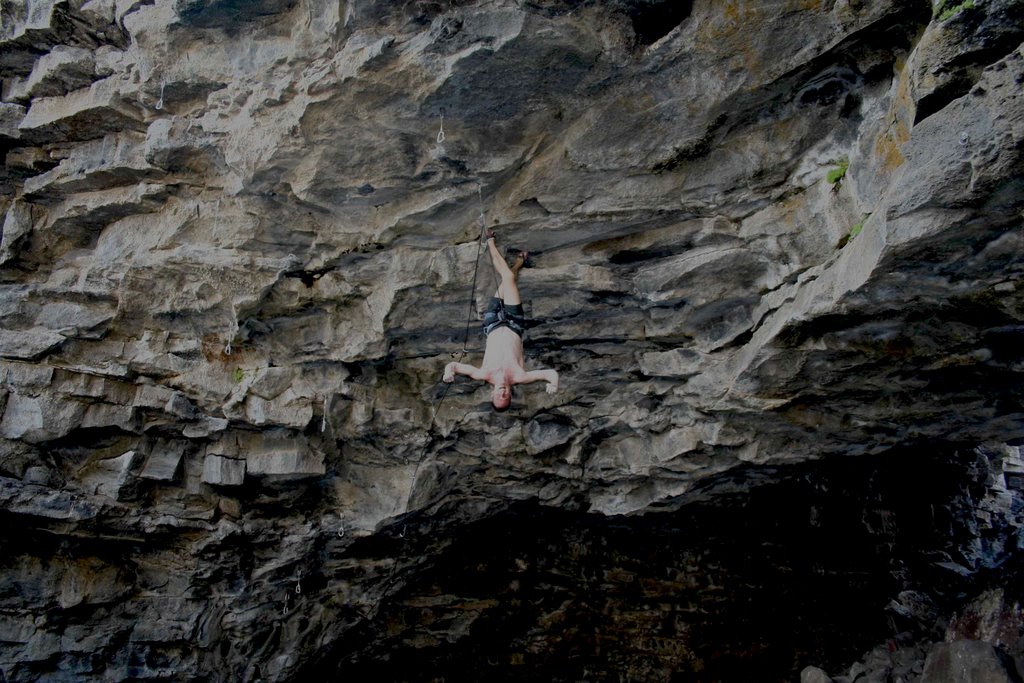
A big cold front is rolling through Sun Valley along with the usual high winds, which put a stop to the meet for the last two days. That's OK, as it was time for another climbing day--we've had three days off from climbing to let our skin heal. We gathered up a good posse of grounded pilots and friends and went back into the lava tube yesterday. It's still hard to believe there's a good climbing area out there in the flat sage brush, but the tube again delivered a lot of desperate pumped climbing and shredded skin. I managed to onsight the remaining 5.12 I hadn't done thanks to some good crowd particpation---I kept blindly dynoing over a lip to a hidden hold, guided by the yells from the crew "An inch higher!" "An inch right!" "No, you halfwit, the OTHER right!" It was comedy. A lively debate ensued about whether an onsight still counted as such with people yelling hold locations to me--none of the crowd had done the route or seen anyone on it, so they couldn't exactly give me beta, but on the other hand it wasn't entirely my skills that got me up it... The debate was solved with beer, I forget how, but that sure was a fun climb, made more so by the group participation. We all shredded our skin to the point where it was impossile to hang onto the sharp basalt for even one more route. I did battle with the tube's hardest established line and got reasonably far on the on-sight before pitching off, a great pump. Lots of fun in a hole in the ground. It's still blowing a hoolie today, so we're going hiking, BASE jumping (not me, I'm done with it), working, etc.
There are some good photos of the PG meet from John Clifford up here, as well as results here. I'm back in a reasonable 9th place and only 230 points out of first after two days, but I know the pace is going to be aggressive the next flying day, a lot of the top pilots failed to make goal last task day and will be in full starving dog-pack mood when we get to fly. The complaint over the conditions on the last task day was resolved, primarily by the big smiles of everyone who got out on course and found the conditions big but definitely reasonable. I have no idea why it was that windy on launch, it was one of the best days of mountain flying I've ever had, just a bit weird off of launch. I'm hoping for three more big tasks, but if we can just get two more flown after the front passes I'd be happy. We need to fly tomorrow or we'll have to go climbing again, it sure does suck to be here in Idaho, grin...
Tuesday, August 29, 2006
U.S. Paragliding Nationals, lava tubes
Sun Valley, site of one this year's US paragliding Nationals, is one of those ultra-rich resort towns in an incredible place. Kim and I arrived a couple of days early to fly, but the first day was too windy so we went for a hike and then headed down south to a very unusual climbing area--a lava tube. There are no mountains around the lava tube, just a huge flat sage brush plain for as far as the eye can see. We couldn't believe there was climbing there, it was odd to walk through the sage and find a pit in the ground. The climbing was super-steep thuggery out the side of the pit, lots of fun. We had a good crew and a good session, only leaving at sunset with lots of ripped skin and sore muscles. I was psyched to send two hard routes (for me), I'm starting to climb decently again and it's a lot of fun.
Day one of the nationals was fantastic, about a 100K task north over the mountains. I was slightly in front of the field as neared about the 15K mark, and had to choose between taking the line with clouds or staying close to the road. I went for a line directly over the heart of the Sawtooths with Len, and the next two hours were simply stunning flying from cloud to cloud with nothing but alpine lakes and big granite cliffs below us. Unfortunately our line was less direct and we ended up being a bit slower to goal, but just flying over such stunning alpine terrain was absolutely worth it. Len landed a bit short of goal, but I was paranoid about my final glide and worked a last thermal higher than I needed to before going on glide and made it in a bit late but with tons of altitude. I'd rate the flight along the Sawtooths one of the top ten flights of my life--I saw a hundred places that I need to visit, and I like flying deep in the mountains. It would have been a very full day walk out if we hadn't found the next thermal, but I was loving the terrain and wouldn't really have minded a nice walk out. Len and I never got low, and of course my oxygen system promptly stopped working so I spent a lot of the day over 15,000 and had a hypoxia headache at the end of the day. Well worth it.
Day two brought an even longer task--125K to the west and north. Launch conditions were a bit erratic and windy, but I watched the pilots in the air and it looked OK so I launched. Unfortunately I just couldn't connect with a good climb for the next 30 minutes. I was wondering why some pilots weren't launching as it was a bit windy but not too bad, I think the combination of less than stellar launch conditions and the prospect of a long task preyed on peopele's minds. Flying is mental, it's always a trick to correctly match one's perception of the conditions with the reality. I know conditions over launch were reasonable as I had to take a pee, so if the glider flew fine for a few minutes without input then it wasn't that whacky.
On course it was tricky as the tops of the climbs weren't that high, and we struggled a bit to get established after crossing the first valley. The first turnpoint took down most of the lead gaggle, and I came in just as they were dirting. I had one of those stupid lucky thermals low and got out with Brian and Dean, then went on one of the most entertaining flights I've had in a long time. We cut the corner between the roads, and were, as they say around here, "deep." The terrain was sun-blasted sage and rolling hills so landing would have been OK, but we were for sure a 20K walk from any reasonable road. Even at 16,000 we would have had a long walk... But there was a good cloud street, so deep we went, and the clouds worked perfectly. About 20km from goal I got low on a after a valley cross, and for some reason it just didn't work despite being perfectly west facing... I realized as I sunk lower and lower that I didn't have a glide out of the bowl I was in, but it was possible to slope-land if I had to. It was frustrating to watch Brian and Dean fly away at base, I'm not sure if I was tired or just had a bit of bad luck. In the end I grovelled out and made it to goal for the longest comp task I'd ever flown, and possibly in US paragliding history. Pretty cool, about 12 people made it in, with Abby, who flew most of the task by himself, winning the day. Nice one Abby!
Unfortunately there was a formal complaint about the launch conditions, and an effort to get the day cancelled. Conditions were a bit windy and messy, but it was far safer yesterday on the Baldy launch than it normally is at other "big" sites such as Chelan. You had to wait for a reasonable cycle to launch in, but there wasn't much chaos once in the air--I'd say the air over launch was mellower than it had been the first day, but the perception on the ground was that it was bad so about 30 people didn't launch. I respect their decision, but the complaint was a bit much given that the air was fine. Each of the previous two days of flying had brough at least one reserve ride and injury, yesterday was totally safe, so I think the people who didn't fly made a good decision for them. I'm not sure Sun Valley is the best place for a non-selective paragliding competition--it's fine for those who enjoy flying "deep" and are used to high-altitude big-air flying, but it's full-on flying for sure. In the end each paragliding day, whether in a competition or not, is up to individual pilots to evaluate. Those who didn't fly yesterday lower the potential points for the day, so that's a legitmate form of saying, "Conditions were more than I wanted to do battle with."
Today is blown out, so we're going back to the lava tubes for another afternoon of skin shredding action!
Day one of the nationals was fantastic, about a 100K task north over the mountains. I was slightly in front of the field as neared about the 15K mark, and had to choose between taking the line with clouds or staying close to the road. I went for a line directly over the heart of the Sawtooths with Len, and the next two hours were simply stunning flying from cloud to cloud with nothing but alpine lakes and big granite cliffs below us. Unfortunately our line was less direct and we ended up being a bit slower to goal, but just flying over such stunning alpine terrain was absolutely worth it. Len landed a bit short of goal, but I was paranoid about my final glide and worked a last thermal higher than I needed to before going on glide and made it in a bit late but with tons of altitude. I'd rate the flight along the Sawtooths one of the top ten flights of my life--I saw a hundred places that I need to visit, and I like flying deep in the mountains. It would have been a very full day walk out if we hadn't found the next thermal, but I was loving the terrain and wouldn't really have minded a nice walk out. Len and I never got low, and of course my oxygen system promptly stopped working so I spent a lot of the day over 15,000 and had a hypoxia headache at the end of the day. Well worth it.
Day two brought an even longer task--125K to the west and north. Launch conditions were a bit erratic and windy, but I watched the pilots in the air and it looked OK so I launched. Unfortunately I just couldn't connect with a good climb for the next 30 minutes. I was wondering why some pilots weren't launching as it was a bit windy but not too bad, I think the combination of less than stellar launch conditions and the prospect of a long task preyed on peopele's minds. Flying is mental, it's always a trick to correctly match one's perception of the conditions with the reality. I know conditions over launch were reasonable as I had to take a pee, so if the glider flew fine for a few minutes without input then it wasn't that whacky.
On course it was tricky as the tops of the climbs weren't that high, and we struggled a bit to get established after crossing the first valley. The first turnpoint took down most of the lead gaggle, and I came in just as they were dirting. I had one of those stupid lucky thermals low and got out with Brian and Dean, then went on one of the most entertaining flights I've had in a long time. We cut the corner between the roads, and were, as they say around here, "deep." The terrain was sun-blasted sage and rolling hills so landing would have been OK, but we were for sure a 20K walk from any reasonable road. Even at 16,000 we would have had a long walk... But there was a good cloud street, so deep we went, and the clouds worked perfectly. About 20km from goal I got low on a after a valley cross, and for some reason it just didn't work despite being perfectly west facing... I realized as I sunk lower and lower that I didn't have a glide out of the bowl I was in, but it was possible to slope-land if I had to. It was frustrating to watch Brian and Dean fly away at base, I'm not sure if I was tired or just had a bit of bad luck. In the end I grovelled out and made it to goal for the longest comp task I'd ever flown, and possibly in US paragliding history. Pretty cool, about 12 people made it in, with Abby, who flew most of the task by himself, winning the day. Nice one Abby!
Unfortunately there was a formal complaint about the launch conditions, and an effort to get the day cancelled. Conditions were a bit windy and messy, but it was far safer yesterday on the Baldy launch than it normally is at other "big" sites such as Chelan. You had to wait for a reasonable cycle to launch in, but there wasn't much chaos once in the air--I'd say the air over launch was mellower than it had been the first day, but the perception on the ground was that it was bad so about 30 people didn't launch. I respect their decision, but the complaint was a bit much given that the air was fine. Each of the previous two days of flying had brough at least one reserve ride and injury, yesterday was totally safe, so I think the people who didn't fly made a good decision for them. I'm not sure Sun Valley is the best place for a non-selective paragliding competition--it's fine for those who enjoy flying "deep" and are used to high-altitude big-air flying, but it's full-on flying for sure. In the end each paragliding day, whether in a competition or not, is up to individual pilots to evaluate. Those who didn't fly yesterday lower the potential points for the day, so that's a legitmate form of saying, "Conditions were more than I wanted to do battle with."
Today is blown out, so we're going back to the lava tubes for another afternoon of skin shredding action!
Thursday, August 17, 2006
An Interesting Day in the Media
I'm a news junkie, and today the habit is getting fed with some very interesting news.
First up, a US Federal Judge has ruled that President Bush's NSA surveillance program is unconstitutional, and in even simpler language, flat-out illegal. This is a slight sign of sanity from the US, and I am actually rejoicing in the news. Bush has long held himself above the law, aruging he can do whatever the hell he wants with the pretext of fighting terrorism. I read a lot about his eavesdropping program and it seemed clearly illegal, but I had about given up on the US ever reigning the Bush adminstration in. Well, it doesn't get much clearer than the judge's words: The program "violates the separation of powers doctrine, the Administrative Procedures Act, the First and Fourth amendments to the United States Constitution, the FISA and Title III." Hell yeah! Finally it's clear that actual freedom counts for something in the US, and that turning into a police state to fight terrorism is no victory for actual freedom. It's time to impeach George Bush, a fitting end to the worst presidency in US history.
Second, I lived down in Boulder when a little girl named Jon Benet Ramsey was murdered. It was huge mainstream news and tabloid fodder for years. We all speculated about the case--I used to ride my bike by the house regularly on the way up to the mountains, it was beyond weird. Today some psycho teaching school in Thailand confessed to the murder. It all seems a bit weird to me and I'm curious what actually happens in the long run, but if true this confession answers some questions and removes the huge cloud of suspicion that had lingered over the heads of her parents.
Now it's time to go climbing, but the net is pretty damn interesting this morning.
First up, a US Federal Judge has ruled that President Bush's NSA surveillance program is unconstitutional, and in even simpler language, flat-out illegal. This is a slight sign of sanity from the US, and I am actually rejoicing in the news. Bush has long held himself above the law, aruging he can do whatever the hell he wants with the pretext of fighting terrorism. I read a lot about his eavesdropping program and it seemed clearly illegal, but I had about given up on the US ever reigning the Bush adminstration in. Well, it doesn't get much clearer than the judge's words: The program "violates the separation of powers doctrine, the Administrative Procedures Act, the First and Fourth amendments to the United States Constitution, the FISA and Title III." Hell yeah! Finally it's clear that actual freedom counts for something in the US, and that turning into a police state to fight terrorism is no victory for actual freedom. It's time to impeach George Bush, a fitting end to the worst presidency in US history.
Second, I lived down in Boulder when a little girl named Jon Benet Ramsey was murdered. It was huge mainstream news and tabloid fodder for years. We all speculated about the case--I used to ride my bike by the house regularly on the way up to the mountains, it was beyond weird. Today some psycho teaching school in Thailand confessed to the murder. It all seems a bit weird to me and I'm curious what actually happens in the long run, but if true this confession answers some questions and removes the huge cloud of suspicion that had lingered over the heads of her parents.
Now it's time to go climbing, but the net is pretty damn interesting this morning.
Tuesday, August 15, 2006
In praise of pointless behaviour
I've done several stellarly pointless things lately. The first involved a bouldering session up an obscure drainage. It wasn't Bishop, it wasn't Joe's Valley, but it was a super fun afternoon. My bud has created terraced landings with engineering skills that would have make any red-blooded man grin. Perhaps one day archaeologists will spot the terraces and wonder about the obscure religious rituals practiced by early twenty-first century Bow Valley residents...
Paragliding yesterday was also really, really pointless. On launch I loaded a sleeping bag, food for two days, insect repellant, maps of the entire Rockies for 300K in every direction and a big bag of food into my paragliding harness. Perfect cumulus clouds filled the sky, it looked epic, and I planned to go big. There are a couple of deep wilderness flights I've wanted to try, the kind where you could spend a couple of days walking out if you couldn't find the next thermal and went down deep in the range. This year has been frustrating for big flights at Golden, but finally base was high and it looked ON. I launched and spent the next hour scratching 20 feet over the trees before landing in the normal LZ with all my gear. I tried again later that day and sunk out again, the first time I've ever failed to get up reasonably high when launching mid-day from Golden. I'm pretty goal oriented--pick a mission that looks cool, do it. Yesterday no mission was accomplished, in fact it was the least rad paragliding I've done in years, and it was super fun. We did handstands in the LZ and threw the ball for Chili until she and we collapsed. Somewhere in there is a metaphor--Chili has chased the ball thousands of times but still goes at it with total abandon and joy. I've sat in LZs around the world and still like it. Both activities are pointless, but it's the sheer fun of doing them that makes them worthwhile. Someone made the point that a lot of the world is a mess, and that we're incredibly lucky to have days where we can do exactly what we want all damn day. Doing something pointless is the finest expression of luxury and freedom that I know.
So here's to doing pointless stuff, whatever it is.
wg
Paragliding yesterday was also really, really pointless. On launch I loaded a sleeping bag, food for two days, insect repellant, maps of the entire Rockies for 300K in every direction and a big bag of food into my paragliding harness. Perfect cumulus clouds filled the sky, it looked epic, and I planned to go big. There are a couple of deep wilderness flights I've wanted to try, the kind where you could spend a couple of days walking out if you couldn't find the next thermal and went down deep in the range. This year has been frustrating for big flights at Golden, but finally base was high and it looked ON. I launched and spent the next hour scratching 20 feet over the trees before landing in the normal LZ with all my gear. I tried again later that day and sunk out again, the first time I've ever failed to get up reasonably high when launching mid-day from Golden. I'm pretty goal oriented--pick a mission that looks cool, do it. Yesterday no mission was accomplished, in fact it was the least rad paragliding I've done in years, and it was super fun. We did handstands in the LZ and threw the ball for Chili until she and we collapsed. Somewhere in there is a metaphor--Chili has chased the ball thousands of times but still goes at it with total abandon and joy. I've sat in LZs around the world and still like it. Both activities are pointless, but it's the sheer fun of doing them that makes them worthwhile. Someone made the point that a lot of the world is a mess, and that we're incredibly lucky to have days where we can do exactly what we want all damn day. Doing something pointless is the finest expression of luxury and freedom that I know.
So here's to doing pointless stuff, whatever it is.
wg
Thursday, August 10, 2006
More Race Willi
This page has all the scores, plus some notes and links to various commentary and some photos.
Thanks to everyone who flew in the Willi, both HG and PG pilots, it was a lot of fun.
WG
Thanks to everyone who flew in the Willi, both HG and PG pilots, it was a lot of fun.
WG
Wednesday, August 09, 2006
Race Willi Paragliding Comp
I've been in Golden running the Race Willi Paragliding competition, a five-day event held in conjunction with the Willi XC event. It's been a really fun five days, with four good competition days. Right now we're downloading the GPS tracks and scoring the last day, I'll put up a link when it's all done. I haven't run a meet in almost 10 years, this one was generally a pleasure thanks to the collective effort. Some competitions are high-stress, this one followed the Willi XC style of "Get it done, have fun, fly safe." Randy Parkin has run the Willi XC for the last few years, and as usual he cooked, flew, and generally kept things happening. Without the Willi XC the Race Willi would never have happened, nor been half as much fun. Where else can you get breakfast every morning, a couple of free dinners and two comps for under $100? Bill Hughes did all the scoring, Kim was co "meet head," it all worked out. We hope to run it next year, it was a good experience thanks to all the help we had frome everyone here.
-wg
-wg
Wednesday, August 02, 2006
The Tour de France sucks
OK, this is a disgression from the normal mountain sports action--I really enjoyed watching the Tour de France this year. I don't even own a road bike anymore, I just like watching the Tour. It was a real race this year for the first time I've watched it, with many leader changes, lots of drama, everything a great sporting event should be. Watching Floyd Landis was pretty damn entertaining, especially after Lance Armstrong's "I am the ice man" routine. Floyd has a bit of country in him, a lot of the geeky bike guy, and a bit of everyman. His collapse and recovery in the Tour was spectacular and heart-warming, which makes the doping results all the more maddening. It's like getting done wrong by a friend--we all expect to get worked by used car salesmen so it's OK, but when a bud does you wrong it feels worse. I cheered for Floyd, and the bastard let me down. "Wait!", says Floyd, "the Tour is making a mistake!" Well, if he didn't cheat and is actually innocent then the Tour de France is a joke--it's either one or the other, and both smell like the ass-end of a rhino. Today the media is reporting that the testosterone found in Floyd isn't the same type his body produces, and that he was almost three times over the limit. If this were a drunk driving case he would have been way too drunk to open the door, never mind drive. It's not a borderline case anymore, so either Floyd was doped to his eyebrows or the Tour de France is making a horrendous mistake. Either way the Tour sucks. Maybe it's time to stop the charade of heart-warming victories and admit road racing is like body-building on 26-inch wheels. "Take all the drugs you want, let's see who can mix the right cocktail for today's stage! See a man ride with blood like honey from all the EPO! See quads explode on live TV!"
Tyler Hamilton says he's innocent also. Either these guys are con artists who have had their scams exposed, or drug testing is ridiculous. Either "truth" stinks.
We will now resume the mountain sports commentary...
Workouts:
I've been climbing a ton, Yoga, even starting to run again. For the last three weeks I've battled this sinus infection, it's just now totally clearing out. I'd forgotten what it was like to smell anything.
Will Gadd, drug-free but revved well past the sane limit on Red Bull.
Tyler Hamilton says he's innocent also. Either these guys are con artists who have had their scams exposed, or drug testing is ridiculous. Either "truth" stinks.
We will now resume the mountain sports commentary...
Workouts:
I've been climbing a ton, Yoga, even starting to run again. For the last three weeks I've battled this sinus infection, it's just now totally clearing out. I'd forgotten what it was like to smell anything.
Will Gadd, drug-free but revved well past the sane limit on Red Bull.
Thursday, July 27, 2006
Sport Climbing, Grades
It's been a great summer in the Canadian Rockies for sport climbing. I've been having these "give 'er" weeks followed by rest weeks due to paragliding or sickness, it's been a lot of fun and my general level is slowly coming up despite the erratic training schedule. About a month ago Utah Scott and I went up to Cougar Creek to the legendary Planet X crag, which took some finding but was well worth it. I think it's the best "hard" crag I've climbed at in Canada, both for the climbing and position. It's also the most "Rifle-like" crag I've climbed on, lots of funk body position and long, continuous routes. I've now done four trips to Planet X, it's my favorite crag for sure. Right now there are only four routes on the overhanging 30M wall, all 12d or harder, with lots of ropes dangling on projects. One project went down yesterday, when Derek sent the rig he had been working on with BC Scott. Likely 14a or so, damn hard looking, congrats to Derek and good luck to Scott, watching these guys climb is inspirational. I'm working Packer, 5.hard for me, yesterday was good 'cause I was finally able to do all the moves and clips thanks to beta from Derek and Scott, who opened the route. I've only climbed one other route of that grade, it's beat me up. It's going to take some time to develop the stamina--generally I get two burns in on Packer and a few others on the mega-classic Shooting Star and Sticky Buns. All the routes are a full 30M, generally 5.11 or easy 5.12 to start and then about 15M of "business." Today my tips and back are blown apart, feels good. Yesterday was almost crowded--there were seven people up there! I haven't sport climbed seriously in about five years, it's fun to get back into it with a motivated crew. Thanks to everybody I've been going up there with, I'm fired up. Paragliding will inevitably get in the way to some extent, it's always a bit of a conflict but this time of year air will always win over rock until about September, but I'm staying after it enough to develop fitness again.
Bow Valley Grade Commentary:
Most of the grades around here are pretty solid, but I've noticed a general grade creep going on in the Bow Valley over the last few years. The new guidebook up-rated some routes a letter grade or two. Some of the classic 12+ routes such as Tintin are now 13a despite being classic 12+ for many years. There's always some grading confusion at every area, but it seems like there's a trend to call many 5.12 routes 5.13. Stygian Ayre is a classic example of this, it's 12c or maybe D max, yet it's become a popular "13a" despite being a short boulder problem. Grades don't matter in the sense of world peace, but they should be reflective of a climb's redpoint difficulty and bear some relation to grades around the world. The flip side of over-grading is under-grading; if you get a route wired enough it may feel easy. Some of the Grassi routes are starting to suffer this syndrome; get some of the 5.12a or b routes hideously wired and they do feel 5.11, but that's not how to rate a route either. To get a valid grade on a route takes a fair number of redpoint ascents by people who climb that grade reguarly. I think what's happening in the Bow Valley is that some people are rating routes based on quick comparisons to one or two other routes roughly in the same grade, not a broad spectrum of routes. Using the softest possible example of a 13a to justify upgrading multiple 12d routes to 13a also doesn't make sense; better to more realistically down-rate the soft 13a to 12d. Grade bitch mode off, give 'er.
Bow Valley Grade Commentary:
Most of the grades around here are pretty solid, but I've noticed a general grade creep going on in the Bow Valley over the last few years. The new guidebook up-rated some routes a letter grade or two. Some of the classic 12+ routes such as Tintin are now 13a despite being classic 12+ for many years. There's always some grading confusion at every area, but it seems like there's a trend to call many 5.12 routes 5.13. Stygian Ayre is a classic example of this, it's 12c or maybe D max, yet it's become a popular "13a" despite being a short boulder problem. Grades don't matter in the sense of world peace, but they should be reflective of a climb's redpoint difficulty and bear some relation to grades around the world. The flip side of over-grading is under-grading; if you get a route wired enough it may feel easy. Some of the Grassi routes are starting to suffer this syndrome; get some of the 5.12a or b routes hideously wired and they do feel 5.11, but that's not how to rate a route either. To get a valid grade on a route takes a fair number of redpoint ascents by people who climb that grade reguarly. I think what's happening in the Bow Valley is that some people are rating routes based on quick comparisons to one or two other routes roughly in the same grade, not a broad spectrum of routes. Using the softest possible example of a 13a to justify upgrading multiple 12d routes to 13a also doesn't make sense; better to more realistically down-rate the soft 13a to 12d. Grade bitch mode off, give 'er.
Sunday, July 23, 2006
Aviation Rules
The following list is from an Australian Aviation mag, my mom sent them to me, good advice:
RULES OF THE AIR
1. Every takeoff is optional. Every landing is mandatory.
2. If you push the stick forward, the houses get bigger. If you pull the stick back, they get smaller. That is, unless you keep pulling the stick all the way back, then they get bigger again.
3. Flying isn't dangerous. Crashing is what's dangerous.
4. It's always better to be down here wishing you were up there than up there wishing you were down here.
5. The ONLY time you have too much fuel is when you're on fire.
6. The propeller is just a big fan in front of the plane used to keep the pilot cool. When it stops, you can actually watch the pilot start sweating.
7. When in doubt, hold on to your altitude. No-one has ever collided with the sky.
8. A 'good' landing is one from which you can walk away. A 'great' landing is one after which they can use the plane again.
9. Learn from the mistakes of others. You won't live long enough to make all of them yourself.
10. You know you've landed with the wheels up if it takes full power to taxi to the ramp.
11. The probability of survival is inversely proportional to the angle of arrival. Large angle of arrival, small probability of survival and vice versa.
12. Never let an aircraft take you somewhere your brain didn't get to five minutes earlier.
13. Stay out of clouds. The silver lining everyone keeps talking about might be another airplane going in the opposite direction. Reliable sources also report that mountains have been known to hide out in clouds.
14. Always try to keep the number of landings you make equal to the number of take offs you've made.
15. There are three simple rules for making a smooth landing. Unfortunately no one knows what they are.
16. You start with a bag full of luck and an empty bag of experience. The trick is to fill the bag of experience before you empty the bag of luck.
17. Helicopters can't fly; they're just so ugly the earth repels them.
18. If all you can see out of the window is ground that's going round and round and all you can hear is commotion coming from the passenger compartment, things are not at all as they should be.
19. In the ongoing battle between objects made of aluminum going hundreds of miles per hour and the ground going zero miles per hour, the ground has yet to lose.
20. Good judgment comes from experience. Unfortunately, the experience usually comes from bad judgment.
21. It's always a good idea to keep the pointy end going forward.
22. Keep looking around. There's always something you've missed.
23. Remember, gravity is not just a good idea. It's the law. And it's not subject to repeal.
24. The three most useless things to a pilot are the altitude above you, runway behind you, and a tenth of a second ago.
25. There are old pilots and there are bold pilots. There are, however, no old, bold pilots.
RULES OF THE AIR
1. Every takeoff is optional. Every landing is mandatory.
2. If you push the stick forward, the houses get bigger. If you pull the stick back, they get smaller. That is, unless you keep pulling the stick all the way back, then they get bigger again.
3. Flying isn't dangerous. Crashing is what's dangerous.
4. It's always better to be down here wishing you were up there than up there wishing you were down here.
5. The ONLY time you have too much fuel is when you're on fire.
6. The propeller is just a big fan in front of the plane used to keep the pilot cool. When it stops, you can actually watch the pilot start sweating.
7. When in doubt, hold on to your altitude. No-one has ever collided with the sky.
8. A 'good' landing is one from which you can walk away. A 'great' landing is one after which they can use the plane again.
9. Learn from the mistakes of others. You won't live long enough to make all of them yourself.
10. You know you've landed with the wheels up if it takes full power to taxi to the ramp.
11. The probability of survival is inversely proportional to the angle of arrival. Large angle of arrival, small probability of survival and vice versa.
12. Never let an aircraft take you somewhere your brain didn't get to five minutes earlier.
13. Stay out of clouds. The silver lining everyone keeps talking about might be another airplane going in the opposite direction. Reliable sources also report that mountains have been known to hide out in clouds.
14. Always try to keep the number of landings you make equal to the number of take offs you've made.
15. There are three simple rules for making a smooth landing. Unfortunately no one knows what they are.
16. You start with a bag full of luck and an empty bag of experience. The trick is to fill the bag of experience before you empty the bag of luck.
17. Helicopters can't fly; they're just so ugly the earth repels them.
18. If all you can see out of the window is ground that's going round and round and all you can hear is commotion coming from the passenger compartment, things are not at all as they should be.
19. In the ongoing battle between objects made of aluminum going hundreds of miles per hour and the ground going zero miles per hour, the ground has yet to lose.
20. Good judgment comes from experience. Unfortunately, the experience usually comes from bad judgment.
21. It's always a good idea to keep the pointy end going forward.
22. Keep looking around. There's always something you've missed.
23. Remember, gravity is not just a good idea. It's the law. And it's not subject to repeal.
24. The three most useless things to a pilot are the altitude above you, runway behind you, and a tenth of a second ago.
25. There are old pilots and there are bold pilots. There are, however, no old, bold pilots.
Subscribe to:
Posts (Atom)